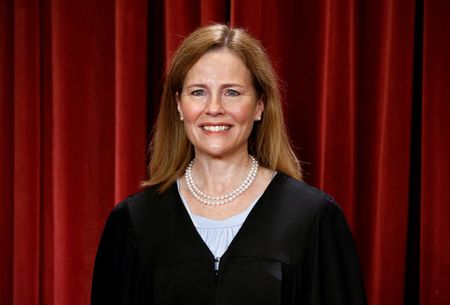

Justice Amy Coney Barrett has cemented her reputation during the U.S. Supreme Court’s most recent term as one of the few members of the court’s 6-3 conservative majority willing to occasionally break ranks — sometimes voting alongside the court’s liberal justices and against the president who put her on the bench, Donald Trump.
Barrett’s 2020 appointment to a lifetime seat on the nation’s highest court during Trump’s first term gave conservatives their current supermajority. She has been a key player as conservative justices have pushed American law sharply to the right this decade, joining decisions that rolled back abortion rights and affirmative action, expanded gun and religious rights, and supported Republican-led redistricting efforts.
But Barrett, 54, became a lightning rod for criticism from Trump and others on the American right this year after voting against some of the president’s biggest priorities. Those included a ruling she authored on Monday that upheld the ability of states to count mail-in ballots that arrive after Election Day, as well as decisions rejecting Trump’s sweeping global tariffs and his executive order limiting birthright citizenship.
Vice President JD Vance weighed in Wednesday on Barrett’s vote in Tuesday’s birthright citizenship ruling, saying, “Do I think she made a mistake in the ruling? I do.”
Conservative commentator Megyn Kelly did not hold back on her SiriusXM show after the mail-in ballot ruling. “Amy Coney Barrett is a turncoat,” Kelly said. “She’s constantly siding with the left.”
Fellow right-wing commentator Matt Walsh called her a “terrible pick” and a “DEI hire” — a reference to diversity, equity and inclusion policies that conservatives strongly oppose.
Mike Davis, a Trump ally who leads the conservative Article III Project, went even further during an appearance on a right-wing political commentator’s show Tuesday. “I think it was the biggest mistake imaginable supporting Amy Coney Barrett,” Davis said. “She is a disaster for the Supreme Court.” He added, “She should resign. She is not up to the job.”
Legal experts, however, push back on the notion that Barrett isn’t a reliably conservative justice. They argue her votes simply reflect the reality that Trump cannot win every case and cannot count on his appointees to back him on every issue — especially during a second term in which he has continued to push the boundaries of presidential authority and reshape the federal government.
“To expect any justice to always vote the way that we wish things were, it’s just complete fantasy, and it misunderstands the entire enterprise,” said Brian Fitzpatrick, a law professor at Vanderbilt University who previously clerked for the late conservative Supreme Court Justice Antonin Scalia.
The court closed out its latest nine-month term with three decisions on Tuesday. Looking at 13 major rulings involving Trump and Republican or conservative interests argued during the term, Barrett sided with those positions 10 times and against them three times.
Among her supportive votes, Barrett backed Trump’s efforts to remove Federal Reserve Governor Lisa Cook and Federal Trade Commission member Rebecca Slaughter. She also sided with Republicans including Vance who challenged campaign finance rules, supported weakening a key Voting Rights Act provision, and backed Trump on ending protections for hundreds of thousands of Haitian and Syrian immigrants and allowing a stricter approach to asylum seekers.
Barrett also voted to uphold state laws in West Virginia and Idaho banning transgender student athletes from competing on female teams at public schools and universities, and to strike down a Colorado law prohibiting psychotherapists from using “conversion” talk therapy aimed at changing an LGBT minor’s sexual orientation or gender identity.
She was also part of the majority in two cases that expanded Second Amendment gun rights — one striking down a Hawaii law that restricted carrying handguns on private property open to the public without the owner’s permission, and another limiting a federal law that bars certain drug users from owning firearms.
The three cases where she broke from Trump and Republican positions were the tariffs ruling, the birthright citizenship decision, and the mail-in ballot case. The mail-in ballot ruling Barrett wrote passed 5-4, with fellow conservative Chief Justice John Roberts and liberal Justices Sonia Sotomayor, Elena Kagan, and Ketanji Brown Jackson joining her.
In her opinion, Barrett wrote that federal law only requires voters to cast their ballot by Election Day. “The election-day statutes say nothing about ballot receipt, and we cannot add to the words Congress chose,” she wrote.
The ruling allows Mississippi to continue counting mail-in ballots postmarked on or before Election Day but received up to five business days after a federal election. Limiting mail-in ballots would generally benefit Republicans, as Democratic voters have historically been more likely to use them.
Trump made three appointments to the Supreme Court during his first term — Neil Gorsuch in 2017, Brett Kavanaugh in 2018, and Barrett two years after that. Trump had previously appointed Barrett to a federal appeals court, and she also served as a law professor at the University of Notre Dame.
Trump selected Barrett, praising her as “one of our nation’s most brilliant and gifted legal minds,” to fill the seat left vacant by the death of liberal Justice Ruth Bader Ginsburg. She was confirmed by a Republican-led Senate over unified Democratic opposition.
At a White House ceremony following her confirmation, Barrett pledged her independence from political influence. “The oath that I have solemnly taken tonight means at its core I will do the job without fear or favor and do it independently of the political branches and of my own preferences,” she said, with Trump standing behind her.
Barrett and Justice Gorsuch joined Roberts and the liberal justices in February to strike down Trump’s tariffs — a signature policy he pursued under a law designed for national emergencies. Trump responded by saying their decision was an “embarrassment to their families.”
On Monday, Trump called the mail-in ballot ruling a “tremendous loss” for his administration.
In the birthright citizenship case, Trump’s directive sought to deny U.S. citizenship to babies born on American soil to certain immigrants. Barrett and the three liberal justices joined a ruling written by Roberts concluding that Trump’s executive order violated the 14th Amendment’s clause granting citizenship to those born in the U.S. who are “subject to the jurisdiction thereof.”
Top White House aide Stephen Miller appeared on Fox News Tuesday and said, “Let’s just call it like it is: Justice Roberts and Justice Barrett decided to cave to the radical left.”
Barrett and Roberts were part of the 6-3 conservative majority in the Slaughter case, which gave Trump one of his biggest wins of the year — expanding presidential power over the federal government and overturning a 1935 precedent that had limited Trump’s ability to remove officials at independent regulatory agencies.
In the Cook case, however, Barrett disagreed with Roberts’ decision to treat the U.S. central bank differently from other federal agencies, writing that the ruling was in “serious tension” with the court’s Slaughter decision.
University of Oklahoma law professor Michael Smith offered a word of caution to American liberals who might be celebrating Barrett’s occasional dissents. “I have been banging the drum, and I will continue: Do not put your hope in Justice Barrett,” Smith said. “She is very much on board with the program of the conservative justices. There is very little reason to hold out hope that she will make much of a difference for liberal goals.”