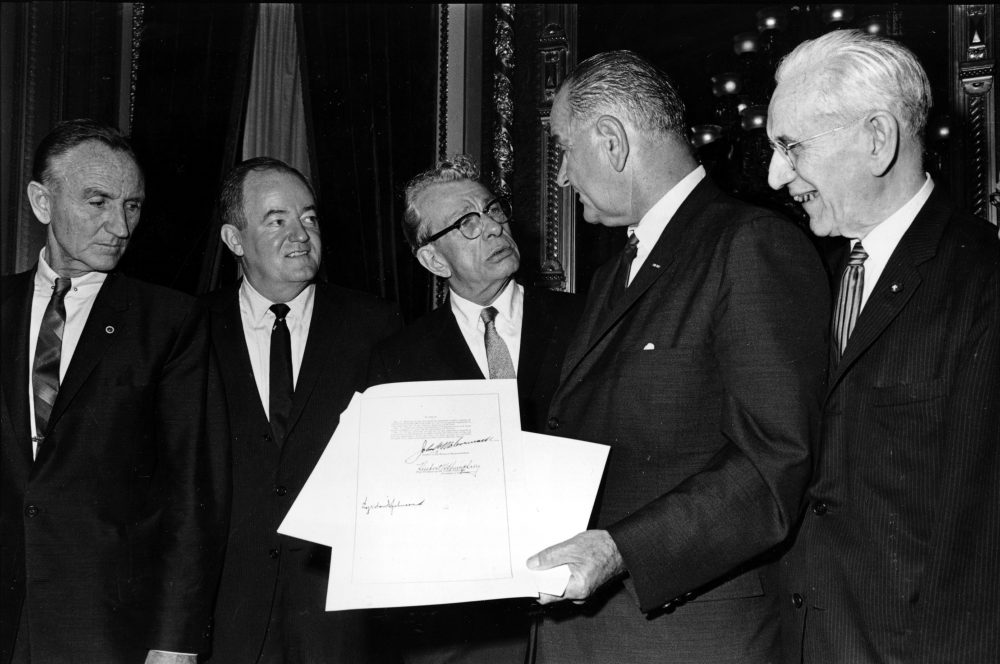

WASHINGTON — When President Lyndon B. Johnson signed groundbreaking civil rights legislation in August 1965, he understood its historic importance and chose to hold the ceremony at the U.S. Capitol rather than the White House.
The signing took place on August 6, 1965, just five months following the violent confrontation known as “Bloody Sunday” in Selma, Alabama, which had galvanized support for what became the Voting Rights Act.
For more than sixty years, this legislation has stood as one of America’s most influential laws, blocking discriminatory practices against minority voters and enabling the election of thousands of Black and Hispanic officials across all government levels.
However, the U.S. Supreme Court delivered a devastating blow to the law’s protections on Wednesday, dismantling another crucial component that had safeguarded against racial bias in voting and political representation. This latest ruling follows the court’s 2013 decision that already weakened other essential aspects of the legislation, subsequently triggering restrictive voting measures across multiple states. Civil rights organizations now express deep concern about the future impact on minority communities.
“It means that you have entire communities that can go without having representation,” said Cliff Albright, a co-founder of the group Black Voters Matter. “It is literally throwing us back to the Jim Crow era unapologetically, and that’s not exaggeration.”
Kareem Crayton, vice president of the Brennan Center for Justice’s Washington office, said the court’s steady work to erode the Voting Rights Act, culminating in Wednesday’s decision, amounted to “burying it without the funeral.”
The high court’s decision emerged from a Louisiana congressional redistricting dispute involving a newly drawn district that resulted in the state gaining its second Black congressional representative.
The court determined this map violated constitutional principles because racial considerations influenced the boundary drawing process. Justice Samuel Alito authored the majority opinion for the court’s conservative wing, arguing that Section 2 of the Voting Rights Act was intended solely to prevent deliberate discrimination.
In her dissenting opinion, Justice Elena Kagan argued that requiring proof of intentional discrimination creates “an almost insurmountable barrier for challenges to any voting rights issues to prove discrimination.”
Legal experts specializing in voting rights warn this decision reduces the Voting Rights Act to a mere shadow of its former strength and opens pathways for political map-drawers across all levels of government — from school boards to state legislatures to Congress — to weaken minority political influence.
“We’re witnessing the evisceration of America’s greatest legislative landmark at the hands of a far right Supreme Court,” Democratic U.S. Rep. Ritchie Torres of New York said.
Maria Teresa Kumar, president of Voto Latino, said the decision will allow more aggressive “cracking and packing” of populations to dilute their votes, “not just in congressional districts but also in state legislatures, county commissions, school boards and city councils.”
The law’s transformative impact over the decades cannot be questioned, according to voting rights specialists.
Sherrilyn Ifill, a law professor at Howard University and the former president of the NAACP Legal Defense Fund, noted that approximately 1,500 Black elected officials served nationwide in 1970, compared to more than 10,000 today.
“And it isn’t because of the goodness of people’s hearts,” she said.
This progress resulted directly from Black communities, civil rights activists and attorneys having legal mechanisms through the Voting Rights Act to challenge attempts to weaken Black and Hispanic voting power. The majority of Section 2 lawsuits have focused on representation in local government positions.
The impact extends beyond mere statistics.
Reduced representation, particularly in state legislatures and Congress, will result in minority communities losing influence on critical issues including healthcare, education and essential infrastructure improvements, according to Sophia Lin Lakin, deputy director of the American Civil Liberties Union’s Voting Rights Project.
“States can now point to partisan objectives to justify maps that strip voters of color of representation, and federal courts will have little basis to intervene,” she said.
Johnson’s historic legislation from 61 years ago underwent various amendments over time, but the most significant change occurred in 2013 with the Supreme Court’s Shelby County v. Holder ruling. That decision effectively eliminated the provision requiring certain states and local jurisdictions to obtain federal approval before implementing voting-related changes.
This 2013 ruling enabled predominantly Republican states to enact numerous restrictive election laws, particularly following former President Donald Trump’s unfounded claims of widespread fraud in his 2020 election loss to Democrat Joe Biden.
In an unexpected 2023 ruling, the Supreme Court had upheld Section 2 in an Alabama redistricting case, but Wednesday’s decision essentially overturned that precedent.
The immediate concern now centers on the consequences for minority representatives and their constituents.
In Louisiana, the ruling places Democratic Rep. Cleo Fields in a precarious position. Fields has experienced redistricting challenges before, serving two terms in the 1990s before the state redrew his congressional district.
“I’ve been down this road before, you know, 33 years ago,” he said.
Shomari Figures, who secured the Alabama seat created following the court’s 2023 decision, explained that while the ruling doesn’t immediately affect Alabama’s current congressional districts, it significantly increases the difficulty of proving future racial discrimination in redistricting cases.
“It will lead to states, primarily in the South, launching immediate efforts to redraw districts in ways that will dilute the impact of Black voters and drastically reduce the number of realistic opportunities to elect Black members to Congress,” he said.
Shalela Dowdy, an Alabama resident who served as a plaintiff in the lawsuit that led to the creation of Figures’ district, expressed concern that the decision could result in rolling back the 2023 district, which provided Black voters with stronger representation.
“Putting it in the hands of the states on this level is dangerous,” Dowdy said. “There’s just been a history of the states not doing the right thing based off their state population.”