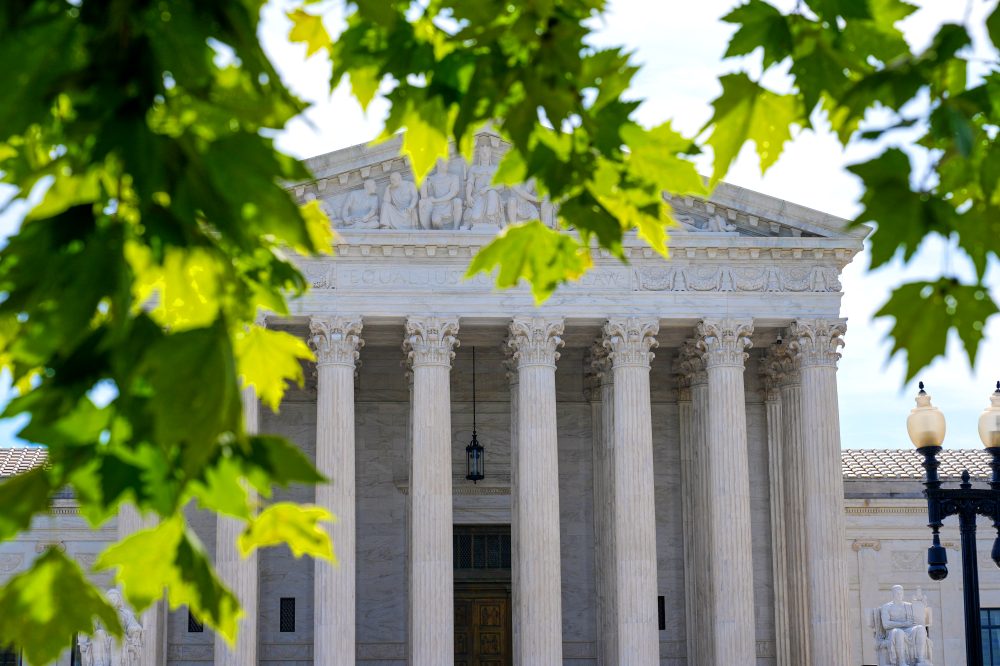

WASHINGTON — The United States Supreme Court announced Monday that it will take up a legal fight over Arizona voting restrictions that Republicans in the state pushed through after the 2020 presidential election.
The nation’s highest court has previously allowed similar measures to go into effect on a temporary basis, including an Arizona rule requiring proof of citizenship for state and local elections and a Virginia voter roll removal effort the state said was intended to prevent noncitizens from casting ballots.
President Donald Trump’s Republican administration entered the case on appeal after federal courts at lower levels determined the Arizona measures ran afoul of federal voting statutes.
The Supreme Court is anticipated to hear oral arguments this fall and issue a final ruling following the midterm elections.
Arizona’s Republican-controlled legislature enacted the laws in 2022. They were part of a broader national movement following Trump’s false claims that rampant voter fraud had cost him his narrow loss in Arizona to Democrat Joe Biden. Trump went on to win the state in 2024, which helped him return to the White House.
The dispute first reached the Supreme Court’s emergency docket in 2024. At that time, the justices gave Republicans a partial win — permitting Arizona to demand proof of citizenship when registering for state and local elections, but not for federal races.
That same year, the high court also allowed Virginia to proceed with removing voters from its rolls in the weeks leading up to the election.
While U.S. citizenship is required to vote nationwide, and registrants must swear under penalty of perjury that they are citizens, Arizona is among only a small number of states that go further by requiring tangible proof such as a driver’s license or passport. Available data suggests that voting by noncitizens occurs very rarely.
Arizona previously attempted to require proof of citizenship for federal elections back in 2013, but the Supreme Court struck down that law. Currently, residents can register as “federal only” voters without submitting proof of citizenship, though Arizona requires additional documentation to participate in state and local elections.