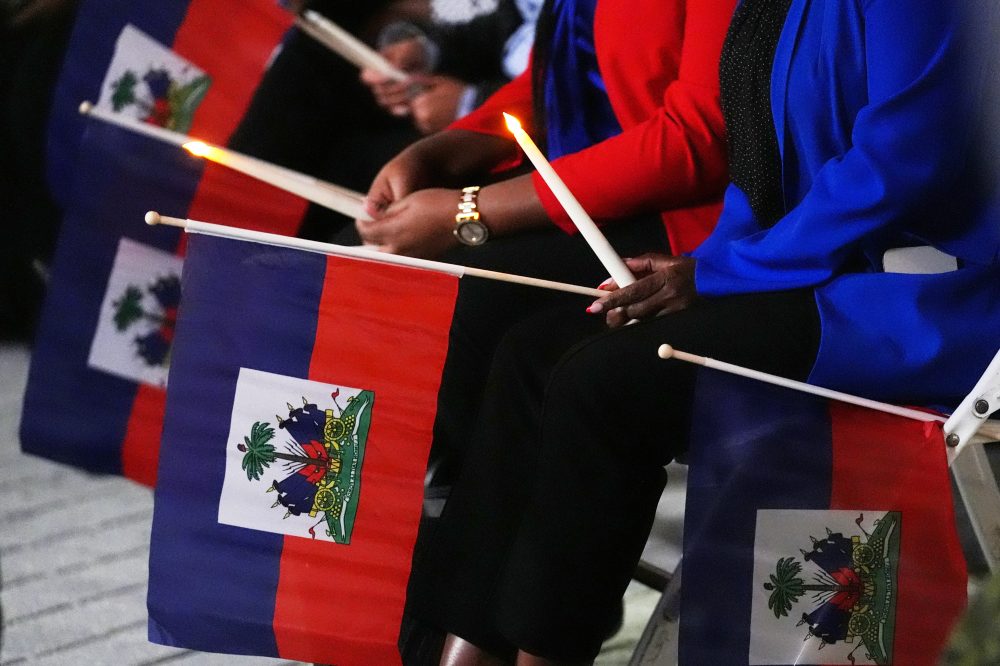

A landmark Supreme Court ruling is opening the door for the Trump administration to eliminate temporary legal protections for hundreds of thousands of Haitian and Syrian immigrants — and the effects could ripple far beyond those two groups.
Thursday’s decision directly affects roughly 350,000 Haitians and 6,000 Syrians currently living and working in the United States under Temporary Protected Status, commonly known as TPS. But legal experts warn it could foreshadow the loss of protections for nearly 1.3 million people from 17 countries — many of whom have spent decades in the U.S. and have American-born children.
The ruling exposes Haitian and Syrian TPS holders to possible detention and deportation. It could also clear a path for hundreds of thousands of other TPS beneficiaries with pending asylum claims or other forms of immigration relief to be forced out of the country.
TPS was established by Congress in 1990 as a way to halt deportations to nations experiencing natural disasters or civil conflict. When President Donald Trump returned to office, Venezuelans made up the largest group of TPS beneficiaries, followed by Haitians and Salvadorans.
To qualify for TPS, individuals must have been continuously present in the United States since the date their country was designated. The Department of Homeland Security can renew the status in intervals of up to 18 months.
The Trump administration has contended that immigrants were inadequately screened after the previous administration significantly expanded the TPS program, and has argued that conditions in those countries are now safe enough for people to return. The administration has already ended TPS for approximately 1 million people from 13 nations, including around 650,000 Venezuelans and 50,000 Hondurans. Decisions are pending for roughly 200,000 Salvadorans and 100,000 Ukrainians whose protections are set to expire soon.
Other countries with smaller numbers of TPS holders include Afghanistan, Myanmar, Cameroon, Ethiopia, Lebanon, Nicaragua, Somalia, South Sudan, and Yemen.
Immigrants whose TPS was revoked by the Trump administration have filed dozens of lawsuits across the country, and many of those cases remain active. Legal observers say courts will now carefully study the Supreme Court’s ruling as those cases proceed.
The government’s position was that the Department of Homeland Security — not federal judges — holds exclusive authority to end TPS protections. The court’s six-justice conservative majority sided with the administration.
Ahilan Arulanantham, co-director of the Miñana Family Center for Immigration Law and Policy at the University of California, Los Angeles, and one of the attorneys who argued on behalf of Syrian TPS holders, called the outcome deeply troubling. “The decision is definitely bad news,” he said. “The implication of this is that at least most of the claims that have been litigated to challenge this administration’s sort of illegal war on TPS are now foreclosed.”
Immigration attorneys argue that both Haiti and Syria remain dangerous and that it is not safe for people to return. They also contend that the administration failed to assess conditions in those countries or consult other government agencies as required under the law.
According to Emi MacLean, a senior attorney at the American Civil Liberties Union of Northern California — which represents TPS holders from Venezuela, Haiti, Honduras, Nicaragua, and Nepal — Supreme Court decisions typically take effect 32 days after they are issued. The case is being sent back to lower courts to carry out the ruling, a process not expected to begin before July 27.
In the meantime, MacLean and other attorneys said, Haitian and Syrian TPS holders can continue to work legally. But that window is short. “In 32 days, everyone from Haiti and from Syria who held their employment authorization through TPS will most likely lose that authorization,” Arulanantham said.
Attorneys and advocates are urging TPS holders to explore other legal options to remain in the country, such as asylum claims or employment-based visas — though the administration has also made those pathways increasingly difficult to access.
Many affected individuals may face a stark choice: leave the country voluntarily or face deportation proceedings. In either case, they risk losing their jobs and being separated from children who were born in the United States.
Each person would revert to whatever immigration status they held before receiving TPS — unless that status has since expired or they have obtained a different legal standing, such as asylum.
Advocates are also pressing Congress to act. Attorney Melissa Keenan, who represents Syrian TPS holders, called on lawmakers to step in. “We also call on Congress to immediately restore these vital humanitarian protections that the TPS program represents for the sake of our clients and TPS holders, their families, and all of our communities,” she said.
While TPS is designed to be a temporary measure, attorneys and advocates say conditions in Haiti and Syria have not improved enough to allow for safe returns. Federal law requires the DHS secretary to consult with other government agencies — potentially including the Department of State, the National Security Council, and the Department of Justice — before designating a country for TPS. TPS holders from Haiti and Syria allege those consultations never took place and that the decision to end their protections was made without any real assessment of conditions on the ground.
Haiti was first given TPS designation in 2010 following a devastating earthquake. Extensions were later granted as gang violence displaced more than a million people, according to court documents. Syria was first designated in 2012 amid a civil war that stretched on for decades until the country’s national government fell in late 2024.