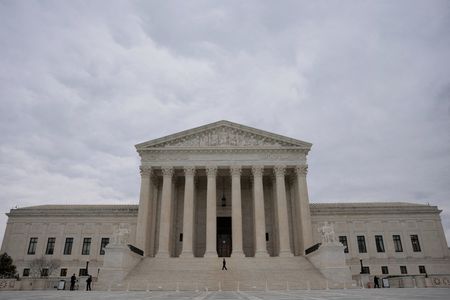

The nation’s highest court on Thursday threw out Alabama’s appeal regarding how courts should assess intellectual disability in death penalty cases, effectively ending a legal dispute over inmate Joseph Clifton Smith’s mental capacity.
The Supreme Court justices declared the case was “improvidently granted,” reversing their earlier decision to hear the matter after oral arguments took place in December.
Alabama officials had challenged a federal court’s methodology for evaluating Smith’s intellectual abilities, which involved examining several intelligence test results along with expert witness testimony.
A landmark 2002 Supreme Court ruling established that putting intellectually disabled individuals to death breaches the Constitution’s Eighth Amendment protection against cruel and unusual punishment. Smith’s case raised questions about whether and how courts may weigh the combined impact of multiple IQ assessments when determining intellectual disability in capital punishment cases.
The Trump administration supported Alabama’s position in the legal battle.
Liberal Justices Sonia Sotomayor and Ketanji Brown Jackson agreed with the court’s dismissal decision. Conservative Justices Clarence Thomas and Samuel Alito opposed it. Chief Justice John Roberts and conservative Justice Neil Gorsuch partially joined Alito’s opposition.
Smith, currently 55 years old, received a death sentence for killing Durk Van Dam in Alabama’s Mobile County in 1997. Court records show Smith used a hammer and saw to fatally attack the victim to steal his footwear, equipment and $140. Authorities discovered Van Dam’s remains inside his stuck Ford Ranger pickup in a remote forested location.
Alabama, similar to numerous other states, uses IQ test results of 70 or lower as part of its criteria for establishing intellectual disability. Supreme Court decisions from 2014 and 2017 permitted courts to examine IQ score ranges near 70 alongside additional evidence of intellectual impairment, including testimony about “adaptive deficits.”
Smith underwent five IQ evaluations, with scores spanning from 78 at the highest to 72 at the lowest. A federal judge observed that Smith’s minimum score might actually reach 69 when accounting for the standard error of measurement of approximately three points either way. The judge subsequently determined that Smith displayed substantial early-life limitations in social interaction, independent living capabilities and academic performance.
The 11th U.S. Circuit Court of Appeals in Atlanta confirmed the judge’s findings in 2023, overturning Smith’s death sentence. This decision led Alabama officials to submit their first Supreme Court appeal in the matter.
In 2024, the justices overruled the 11th Circuit’s ruling, stating that the appeals court’s analysis of Smith’s IQ results was ambiguous and needed clarification.
The 11th Circuit issued a clarifying opinion explaining that its assessment employed “a holistic approach to multiple IQ scores” while also examining additional pertinent evidence, including expert testimony. This clarification prompted Alabama officials to file their second Supreme Court appeal.