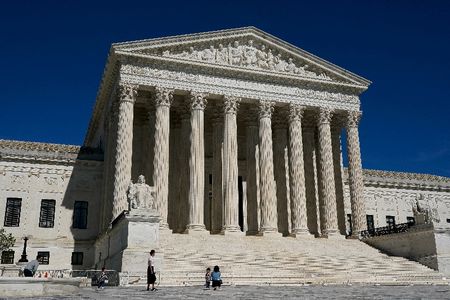

The nation’s highest court on Friday turned down an appeal from Virginia Democrats who sought to implement a congressional voting map that would have benefited their party in November’s midterm elections.
In a brief unsigned order without explanation, the justices chose not to intervene in a Virginia Supreme Court decision that prevented the implementation of a voter-approved redistricting plan. No justice publicly disagreed with the decision.
The proposed electoral boundaries were designed to convert four Republican-controlled House seats to Democratic ones, representing part of a broader national redistricting battle that began last year under President Donald Trump’s direction to redraw district lines for political advantage.
This decision by the conservative-majority court follows their Monday action that allowed Alabama Republicans to move forward with a congressional map more advantageous to their party before the midterms.
November’s elections will determine congressional control, with Republicans currently maintaining narrow majorities in both chambers. Virginia sends 11 representatives to the 435-member House.
On May 8, Virginia’s highest court voted 4-3 to invalidate the state’s voter-approved redistricting plan, siding with Republican challengers. The court determined that Democratic legislators failed to follow correct procedures when they hurried to pass the referendum through the state legislature to place it before voters ahead of the midterms.
Don Scott, the speaker of the Virginia House of Delegates, along with other Democratic lawmakers, petitioned the U.S. Supreme Court on Monday to block the state court’s decision, arguing it had “deprived voters, candidates and the Commonwealth (Virginia) of their right to the lawfully enacted congressional districts.”
They referenced a 2023 Supreme Court decision stating that state courts “may not transgress the ordinary bounds of judicial review such that they arrogate to themselves the power vested in state legislatures to regulate federal elections.”
The Virginia ballot measure represented the concluding phase of an intricate legislative strategy to bypass a state constitutional amendment approved by voters in 2020 that transferred redistricting authority to a bipartisan commission.
Virginia Senate Republican Leader Ryan McDougle, among the case plaintiffs, praised Friday’s court decision.
“The Supreme Court of the United States has affirmed what we always knew: you cannot violate the Constitution to change the Constitution,” McDougle said.
Virginia voters endorsed the Democratic-supported electoral map in an April 21 special election by a margin of 51.7% to 48.3%, with approximately 3.1 million ballots cast.
Through a process known as redistricting, legislative district boundaries nationwide are redrawn to account for population shifts documented by the national census every decade. State legislatures have traditionally handled redistricting at each decade’s beginning.
In this unusual mid-decade redistricting battle currently developing, Republicans maintain a distinct advantage.
Following Trump’s encouragement, Republican-controlled Texas redrafted its electoral boundaries last year attempting to capture five Democratic-held House seats, leading Democratic-controlled California to restructure its congressional map targeting five Republican-held seats. Several additional states have entered this competition.
Democrats experienced a setback when the Supreme Court’s 6-3 conservative majority in April weakened a crucial section of the 1965 Voting Rights Act, enabling Republican-led Southern states to eliminate Democratic-held majority-Black and majority-Latino districts before November’s elections. Black and Latino voters typically favor Democratic candidates.
Highlighting the significance of Virginia’s redistricting effort, Democratic and Republican organizations invested nearly $100 million in the referendum campaign.
The ballot initiative has encountered numerous legal challenges. Beyond the Supreme Court dispute, a judge in a separate case on April 22 also halted the pro-Democratic map, responding to a lawsuit filed by the Republican National Committee.