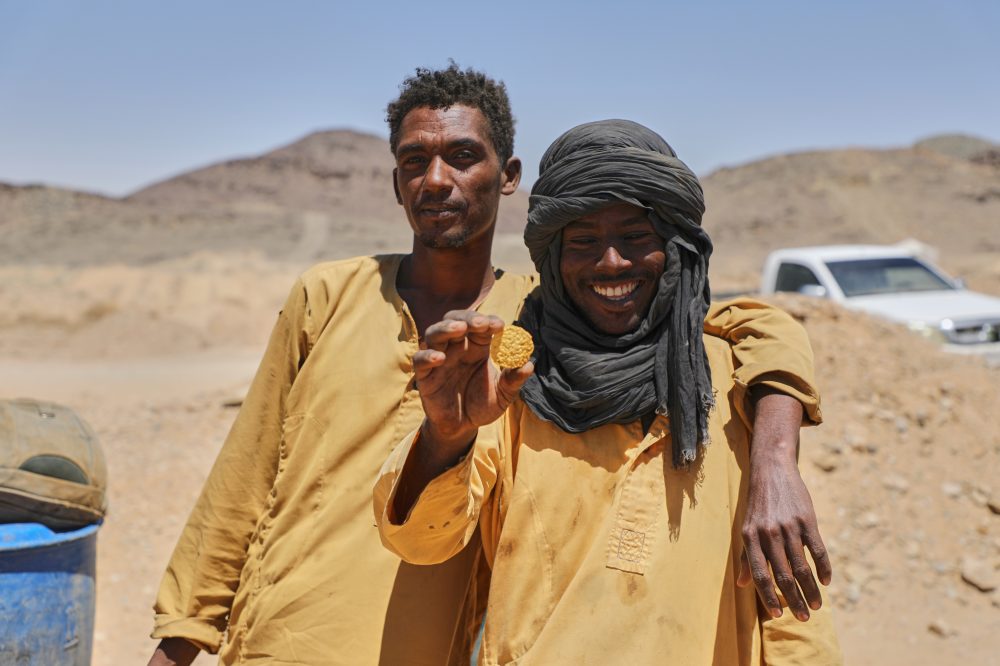

Workers equipped with metal detectors searched mountainous terrain in northern Sudan, hunting for gold deposits in conditions lacking even basic safety protections. One miner crouched down with a digging implement to probe the earth for valuable ore.
These unregulated workers operate at a small private gold extraction site in the northern community of Dalgo Mahas. This facility represents just one among thousands of small and artisanal mining operations spread throughout Sudan, forming part of an industry central to the destructive conflict that has occasionally driven regions of the nation toward starvation.
The precious metal emerged as a crucial revenue source for Sudan’s national treasury following the loss of more than two-thirds of oil income when South Sudan gained independence in 2011. Gold represented 70% of national income in the years following South Sudan’s separation, supplying the Sudanese administration with essential foreign currency.
Currently, gold sits at the heart of the continuing conflict between military forces and the paramilitary Rapid Support Forces. Substantial amounts of gold have been illegally transported from the country to fund paramilitary groups, who maintain control over gold-producing territories in Darfur and Kordofan regions, according to United Nations-commissioned experts.
The fighting has resulted in the deaths of at least 59,000 individuals, according to the Armed Conflict Location & Event Data Project, a U.S.-based war tracking group that says its toll is almost certainly an underestimate, given the difficulties in reporting.
The conflict also generated the globe’s most severe humanitarian catastrophe, compelling over 10 million individuals to abandon their residences. Numerous displaced persons entered the mining sector to support their families financially.
“Gold mining is the only thing I can rely on,” said Atta al-Khazin, a 28-year-old miner who abandoned his previous profession as a farmer. “Due to the high oil prices, agriculture no longer covered expenses.”
Zahir Adam, a 35-year-old father from the Darfur city of el-Fasher who worked in gold mining for more than a decade, said the sector has drawn many people since the war broke out over three years ago.
They had “no other option,” he said. “Many young people, and many families, depend on mining.”
Sudan extracted 70 tons of gold during the previous year, increasing from 64 tons in 2024, according to official figures, positioning it among Africa’s leading producers. Gold brought in approximately $1.8 billion in income during 2025, data from the state-run Sudanese Mineral Resources Company indicated.
Small-scale and artisanal gold extraction represents the bulk of gold recovered in the vast nation, where safety protocols are mostly disregarded.
Independent miners like those working in Dalgo Nahas typically remove the gold, then pulverize the raw material before adding poisonous mercury to form an amalgam. The mixture is subsequently heated, often using a stove, to eliminate the mercury and retrieve the gold.
This procedure, involving dangerous chemicals, also poses threats to residents living close to mining sites.
Government oversight does not extend to many of these operations. The U.N. panel of experts stated in their 2024 report that more than 50% of the gold mined in Sudan was not traded through formal channels but was smuggled out of the country.
Fatal mining cave-ins occur regularly in Sudan, where safety requirements are not broadly enforced. During the previous month, no fewer than seven miners perished in a mine collapse within the Red Sea province. Thirteen additional workers died in another collapse in South Kordofan province during January.
A civilian transitional government that ruled the country for over a year after the military overthrow of longtime dictator Omar al-Bashir in April 2019 attempted to regulate the crucial industry.
However, its efforts were aborted by a military coup in October 2021, and the war that began in 2023.