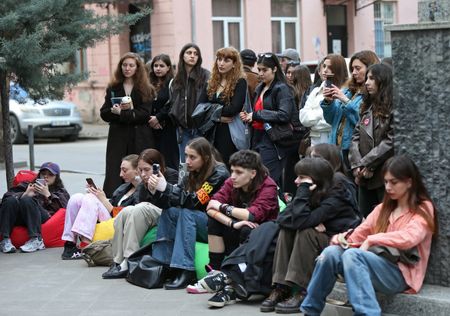

Student activist Luka Mishveladze has transformed from sleeping on university floors during protests to leading demonstrations against education reforms threatening to close his school.
The 20-year-old began his activism when anti-government demonstrations erupted across Georgia in late 2024. Now, 18 months later, he finds himself rallying outside the same Tbilisi building where he once studied, fighting to save his academic home.
“It was hard for me to realise that this was happening in reality, that I am losing my university, the place I am used to calling home,” Mishveladze told Reuters.
Critics view the education overhaul approved in February as another step in the ruling Georgian Dream party’s pivot away from Western partnerships toward Russian influence, a trend that accelerated following Moscow’s 2022 invasion of Ukraine.
The former Soviet republic, once viewed as a promising democracy on track for European Union membership, has increasingly distanced itself from Western alliances while strengthening Moscow connections.
CENTRALIZED CONTROL OVER UNIVERSITIES
Georgian Dream officials defend the education changes as necessary market-driven adjustments designed to strengthen regional institutions and improve resource allocation.
Government leaders claim they want to eliminate what they describe as excessive concentration of universities in the capital city and end wasteful spending practices.
Opposition voices argue the reforms represent further evidence of the administration’s effort to steer the nation of 3.7 million citizens away from Western integration, more than thirty years after breaking free from Soviet control.
The new system operates under a “one faculty, one city” framework, restricting multiple universities in the same location from offering identical degree programs.
State officials will determine which academic subjects each of the 19 public institutions can teach and will reallocate student enrollment limits across the system that serves more than half of Georgia’s college students.
Ilia State University in Tbilisi, where Mishveladze and approximately 17,300 other students attend classes, faces the most severe impact. The highly-ranked research institution, known for its outspoken liberal stance and extensive European partnerships, will see dramatic cuts.
University administrators report that over 90% of their academic programs will be eliminated, forcing a three-year shutdown process. This fall, ISU can only accept 335 new undergraduate students, compared to 3,770 admitted the previous year.
“No other sector in Georgia has been so integrated into the European space than higher education. So they’re killing it,” said Ketevan Darakhvelidze, the chancellor of ISU. “The more isolated Georgia will be, the better for the government.”
Seven additional universities received reduced enrollment quotas, though only ISU reports facing complete closure.
Education policy researcher Shalva Tabatadze noted that government funding in Georgia has historically supported universities “which have political affiliations,” calling this practice “problematic.”
A March assessment by the Organization for Security and Co-operation in Europe identified “marked democratic backsliding” in Georgia and referenced concerns about the education reforms. The report suggested the faculty redistribution might be designed to scatter large student protest groups.
Government officials did not respond to Reuters’ requests for comment. Education Minister Givi Mikanadze, who served on the committee developing the reforms, also declined interview requests.
Georgian Dream, governing since 2012, rejects accusations of authoritarianism and maintains its policies aim to preserve peace in Georgia, which suffered defeat in a brief 2008 conflict with Russia. Party leaders accuse opposition groups of attempting violent overthrows.
ACADEMIC FREEDOM UNDER THREAT
Student and faculty opposition to the changes has energized nightly anti-government demonstrations that began when officials announced suspension of EU membership negotiations in late 2024.
While the relatively modest rallies don’t threaten government stability, they have gained support at universities throughout Georgia.
“They are going to shut down every free-thinking institution capable of critical reasoning,” said ISU sociology professor Nino Rcheulishvili.
Since its 2006 establishment, ISU has developed partnerships with 145 European institutions for joint degree offerings.
“All those programmes are at risk,” said Nino Doborjginidze, ISU’s rector, noting that recent legislative changes could eliminate access to most international grants.
Protesters achieved one small success when the government abandoned plans to merge two Tbilisi universities in February, but many young people still consider leaving Georgia.
Twenty-year-old Davit Mshvenieradze represents students contemplating departure, though he wants to see Georgian Dream removed from power first.
“If they are here (in power), I want to stay here and protest against them,” he said.