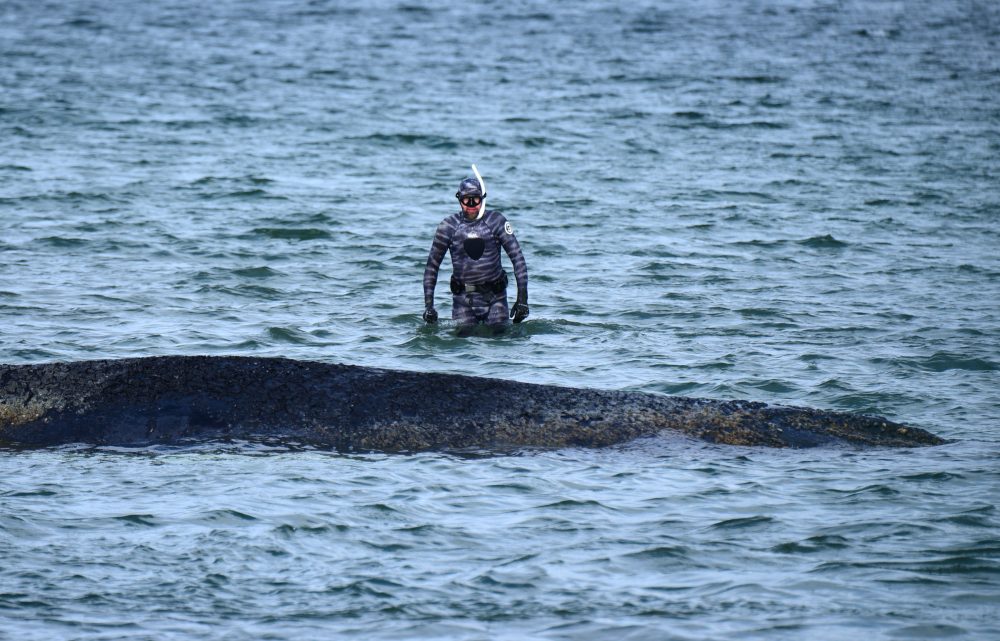

BERLIN — A massive whale that spent several days trapped in shallow waters at a German resort has successfully escaped through a rescue channel, though marine experts warn the animal remains in serious danger.
The marine mammal, measuring between 39 and 49 feet in length, swam through a specially dug escape route during overnight hours after rescue teams worked tirelessly with heavy machinery to create the pathway. Marine biologist Robert Marc Lehmann confirmed the whale’s movement Friday morning, according to German news agency dpa.
However, Lehmann emphasized that this development represents just a minor victory for the enormous creature. “It was only a small step in the right direction for the marine mammal,” he said, noting “it will only really be at home again if it reaches the Atlantic Ocean.”
The rescue drama began Monday morning when the whale became stuck on an underwater sandbank near Timmendorfer Strand, a well-known vacation destination. Emergency responders initially attempted various methods to free the animal, including deploying coast guard vessels and fire department boats to generate powerful waves that might dislodge it. These efforts proved futile, partly because the Baltic Sea’s weak tidal action couldn’t provide natural assistance.
By Thursday morning, rescue teams escalated their approach by bringing in excavation equipment to carve out a trench directly in front of the whale’s head. Lehmann personally approached the stranded animal to help direct the digging operation. The crew continued their work well past nightfall but couldn’t complete the whale’s liberation before darkness forced them to halt operations.
Early Friday, the whale was making its way out of Lübeck Bay, the body of water where Timmendorfer Strand sits, according to Stephanie Gross from the Institute of Terrestrial and Aquatic Wildlife Research. She reported that the massive creature, positioned roughly 1,000 feet from shore, was being monitored by a coast guard vessel along with several accompanying boats.
Wildlife specialists believe the animal is likely a young male, since male whales typically undertake migration journeys while females do not. The whale also appears to match descriptions of the same animal observed multiple times in recent weeks at Wismar port, located east of the stranding site.
The reason behind the whale’s presence in the area and subsequent stranding remains unclear to researchers.
Humpback whales do not naturally inhabit Baltic Sea waters. This particular whale must now navigate several hundred miles through German and Danish territorial waters before it can hope to reach the North Sea and eventually return to the Atlantic Ocean.