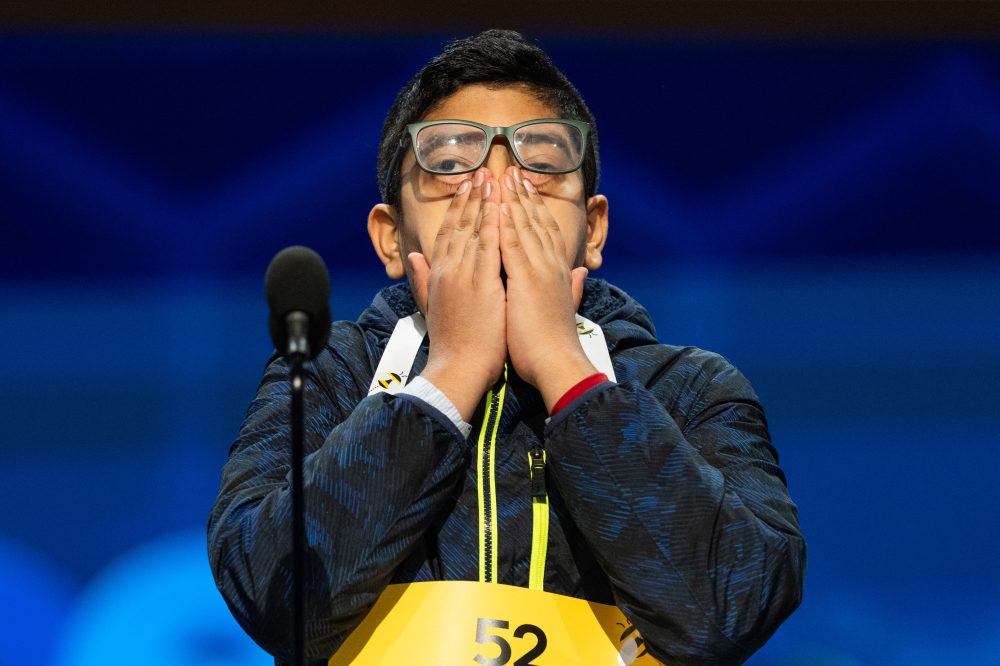

Two dramatically different approaches to spelling success are on display as 54 young competitors vie for spots in Thursday’s National Spelling Bee finals.
Shrey Parikh, a 14-year-old from Rancho Cucamonga, California, exemplifies the intensive preparation method. After placing third in the 2024 competition but stumbling at his school bee last year, he’s gone all-in for his final eligible year. The teenager works with three different coaches, purchases specialized word lists and study materials, and dedicates himself to mastering Greek and Latin roots along with language patterns. He also participates year-round in online competitions against the nation’s elite spellers.
In stark contrast stands 12-year-old sixth-grader Sarv Dharavane from Dunwoody, Georgia, who also secured third place in 2025 despite being relatively unknown in spelling circles. His secret? Complete reliance on the Merriam-Webster’s Unabridged dictionary as his sole study companion.
“The book is my coach,” Sarv explained.
His methodology remained unchanged from his previous success. “I didn’t really change anything because my strategy got me far last year, but I did more of what I did before,” he noted. “I used to read the dictionary and set aside difficult words to study later. I did it a lot, so I got a lot of words and it was really easy just to go through them. I’ve always been able to remember pretty well, and I can read through long lists without getting tired, so this strategy works pretty well for me.”
These contrasting methods have reignited an ongoing discussion within spelling communities about whether language comprehension or memorization techniques prove more effective.
Sam Evans, who has coached the previous two champions, advocates for memorization’s importance. “At the end of finals, most of the words aren’t going to have a really clean-cut language pattern or rule that you can pull from. So I think memorization is really important,” he stated. “Sometimes it gets a bad reputation, but you have to do it.”
Reaching the finals typically requires understanding word components absorbed into English, including roots and origin languages. However, certain champions have distinguished themselves through exceptional memory capabilities – the capacity to immediately visualize encountered words or recite dictionary definitions word-for-word. This group includes Nihar Janga in 2016, Zaila Avant-garde in 2021, and Bruhat Soma in 2024.
Dev Shah, the 2023 winner, promotes what he calls an artistic spelling methodology, also supported by his coach Scott Remer. This approach emphasizes mastering roots and language patterns while learning to identify exceptions, enabling spellers to tackle unfamiliar words through deduction rather than recall.
Shah acknowledged the impossibility of memorizing the entire dictionary – “No one can,” he said – and believed unknown words could be solved through reasoning. “The skill of guessing is everything,” he wrote in a Washington Post opinion piece following his victory.
In a Wednesday interview, Shah recognized memorization’s value, particularly for unusual words with obscure backgrounds. He identified the top spellers, including Avant-garde, as those who balance memorization with mastery. Understanding conceptual spelling principles can also support performance under pressure when memory lapses occur, Shah noted, admitting he finds memorizing vast word volumes challenging.
Former champion Sohum Sukhatankar, who coaches Shrey, emphasizes loading competitors’ minds with the most valuable information. “When you’re at the highest level, you have to be prepared for hundreds of thousands of words,” he explained. “You want to do as little memorization as possible to avoid the chance that you just forget it, so it’s all about efficiency.”
While Shrey recognizes he may need to guess at the microphone, he aims to minimize uncertainties. This approach makes sense considering last year’s setback when he failed to become his school’s top speller.
“I had a fever at my school bee last year, and I just blanked on the word ‘calipers’ … and I missed it,” he recalled. “I was really devastated.”
Several months passed before Shrey felt motivated to resume studying. Upon restarting, he added Sukhatankar to his coaching roster. He’s developed techniques for slowing down at the microphone following a negative 2023 experience when rushing through a word led to unclear pronunciation and an incorrect ruling from judges.
Shrey also supports study guide usage. He credits an interactive, AI-powered platform called Onyma – offering personalized learning and inter-speller competition, launched this month by Sukhatankar and Evans – with improving his preparation. Additionally, he utilizes SpellPundit, an online resource developed by former spellers and their parents that gained prominence at the 2019 bee when most of that year’s eight co-champions used it. The company reports every subsequent champion as a client.
Despite winning the annual SpellPundit bee, the South Asian Spelling Bee, and several other online competitions, Shrey doesn’t view these victories as necessarily beneficial. “I feel like it (creates) more pressure to perform,” he said.
Evans believes spellers seeking victory should maximize study time efficiency, though no limits exist on learning every possible word. “There’s a common joke among spellers that says everything’s in the dictionary, so it’s all ‘on-list,’” he noted. “The dictionary is the most basic thing that spellers need to know.”