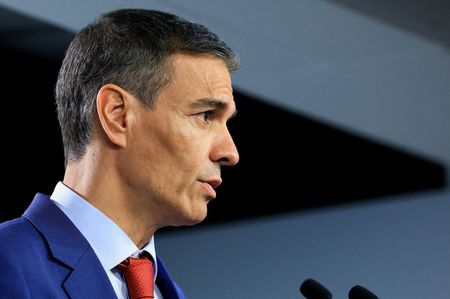

Spanish Prime Minister Pedro Sanchez is walking a political tightrope, using his opposition to Trump administration policies to boost his standing at home while risking damage to Spain’s relationship with its powerful American ally.
The Socialist leader has openly challenged Washington on multiple fronts – criticizing U.S. involvement in Venezuela, advocating for tighter social media regulations, and refusing to meet NATO’s defense spending requirements. His approach has drawn sharp warnings from political advisers connected to the White House.
Sanchez, representing one of Europe’s few remaining left-wing voices in leadership, has deliberately positioned his policies as alternatives to President Trump’s approach. In a New York Times opinion piece, he accused “MAGA-style leaders” of misleading the public about immigration dangers and described his social media proposals as “making social media great again.”
His supporters argue he’s maintaining popular positions that resonate with voters and allies in the Global South, where Europe seeks stronger partnerships to reduce reliance on both the United States and China.
However, Trump administration advisers warn that Sanchez is taking dangerous risks, particularly regarding defense spending, which has repeatedly drawn Trump’s criticism.
Benjamin Leon, the newly confirmed U.S. ambassador to Madrid and longtime Republican donor, told senators during his confirmation that he would pressure Spain to meet NATO’s 5% GDP spending target – a commitment Sanchez has consistently rejected.
Spain’s decision to ban weapons shipments to Israel from using its ports has triggered a U.S. investigation that could lead to restrictions on Spanish shipping to America.
When asked about relations with Sanchez, a State Department representative emphasized Leon’s appointment and expressed hope for cooperation on “common challenges.”
“I want to get along with Spain,” said Wilson Beaver, a senior defense adviser at the Heritage Foundation, a conservative think tank aligned with Trump. “It’s Prime Minister Sánchez getting in the way.”
Joshua Trevino from the America First Policy Institute said Spain “nearly stands alone in its willingness to be on the wrong side of the U.S. on all these issues.”
While most European nations have chosen to accommodate Trump privately to advance their interests, some have grown frustrated with Sanchez, particularly his refusal to match their defense spending commitments.
“He’s playing to a domestic anti-Trump and anti-American audience to great effect, leaving both transatlantic and European solidarity at the wayside,” said one unnamed European diplomat.
Domestically, Sanchez faces political pressure from scandals and disputes with coalition partners that have blocked his legislative priorities. Foreign policy offers him a chance to demonstrate leadership, according to analysts and pollsters.
His stance taps into historical Spanish resentment toward America, rooted in U.S. support for dictator Francisco Franco after World War II in exchange for military base access.
A recent YouGov survey showed 66% of Spaniards view the U.S. unfavorably, up from 45% before Trump’s second term started.
Sanchez’s other international positions enjoy widespread domestic support. Polling shows most Spaniards consider Israel’s Gaza actions genocidal – which Israel disputes – and oppose U.S. intervention in Venezuela. An Ipsos poll found over 80% backing his proposal to prohibit social media use for children under 14.
Defense spending divides Spanish opinion, but left-leaning voters support his lower spending pledge, surveys indicate.
“These are areas where he can set the agenda, offsetting the image of paralysis and reinforcing his profile as a bulwark against the far right,” said Paula Canas, an analyst at GAD3.
Conservative opposition members blame Sanchez for Spain’s exclusion from a U.S.-led critical minerals trading group and preparatory sessions for December’s G20 summit.
Despite criticism, Sanchez appears undeterred. Someone familiar with his policy-making process said he has strong instincts for international affairs and, while willing to speak boldly, understands diplomatic boundaries.
Three sources close to Sanchez maintain that U.S.-Spain relations remain solid, with diplomatic communication continuing normally.
His allies point to Greenland, where Trump’s annexation threats prompted European leaders to take a firm stance that ultimately forced a retreat.
“The current administration will respect you if you defend your interests, not if you project weakness and pretend to be what you are not,” said Arancha Gonzalez Laya, dean at Paris’s Sciences Po university and Sanchez’s former foreign minister.
“Many European leaders have tried to appease Trump. Spain has no desire to change or hide its policies … That stands out because of the silence of others.”
Spain’s trade deficit with the U.S. also provides protection against punitive tariffs compared to major exporters like France or Germany, said Ignacio Molina, senior fellow at Spain’s Royal Elcano Institute.
“Sanchez has an incentive to continue this path. It’s very difficult for the U.S. to punish Spain,” Molina said. “He has more to gain than to lose.”