
WARSAW, Poland (AP) — Polish officials announced Friday that the nation has formally exited an international agreement that prohibited antipersonnel mines, with plans to manufacture and deploy these weapons along its eastern frontier as protection against potential Russian threats.
The Ottawa Convention of 1997, which forbids member nations from producing or deploying antipersonnel mines, lost Poland as a signatory after the country determined these weapons were essential for border security. These explosive devices have historically caused significant civilian casualties in post-conflict regions across Cambodia, Angola, and Bosnia and Herzegovina, often remaining dangerous long after wars end.
After joining the agreement in 2012 and eliminating its entire stockpile of antipersonnel mines by 2016, Poland reversed course and officially departed the treaty Friday, announcing intentions to restart weapon production.
Deputy Defense Minister Paweł Zalewski explained to The Associated Press that “These mines are one of the most important elements of the defense structure we are constructing on the eastern flank of NATO, in Poland, on the border with Russia in the north and with Belarus in the east.”
Zalewski justified the decision by pointing to Russia’s hostile behavior, describing it as a nation with “very aggressive intentions vis a vis its neighbors” that never agreed to the international mining prohibition.
Following Russia’s comprehensive attack on Ukraine, neighboring nations have reconsidered their commitment to the mining ban. Warsaw joined Finland and the Baltic nations of Estonia, Latvia, and Lithuania, along with Ukraine, in announcing their departure from the treaty last year.
Russia remains among approximately three dozen nations, including the United States, that never joined the Ottawa agreement.
According to Zalewski, Poland will launch domestic manufacturing of both antipersonnel and anti-tank explosive devices, working alongside Polish companies to achieve independence in mine production.
These weapons detonate when individuals or vehicles pass over them, with anti-tank versions specifically engineered to avoid triggering from human weight alone. The Ottawa Convention permits anti-tank mines.
During a Thursday presentation of the Bluszcz, an automated vehicle created by Polish firm Belma S.A. and military researchers to distribute anti-tank mines, Prime Minister Donald Tusk announced Poland would “soon” possess the capability to mine its eastern boundaries within two days if threatened.
Considering the extensive length of Poland’s eastern frontier, Tusk noted that substantial quantities of mines would be required.
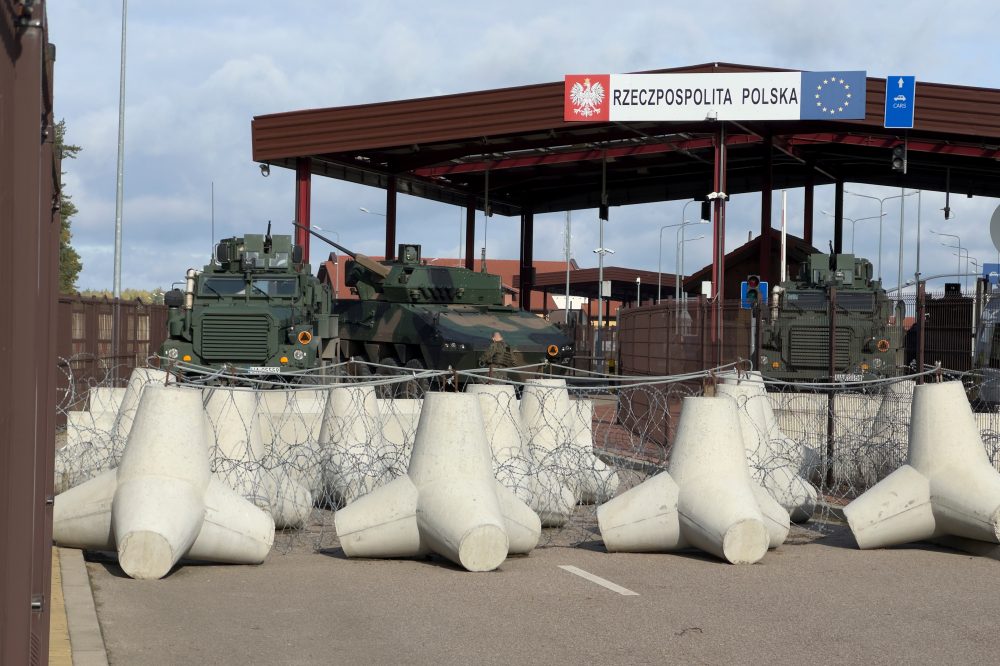
The mining initiative forms part of Poland’s Eastern Shield project, a comprehensive fortification system the country began constructing along its Belarus and Russia borders in 2024, Zalewski explained.
However, he emphasized that mine deployment would occur only “when there is a realistic threat of Russian aggression.”
“We very much respect our territory and we don’t want to exclude it from day to day use for the Polish citizens,” Zalewski stated.
Human rights organizations have criticized nations abandoning the Ottawa Convention, warning that antipersonnel mines pose excessive risks to civilian populations.
Zalewski countered that Poland maintains balance by keeping mines in storage unless facing attack.
“We are not an aggressive country,” he declared, “but we have to use all means to deter Russia.”