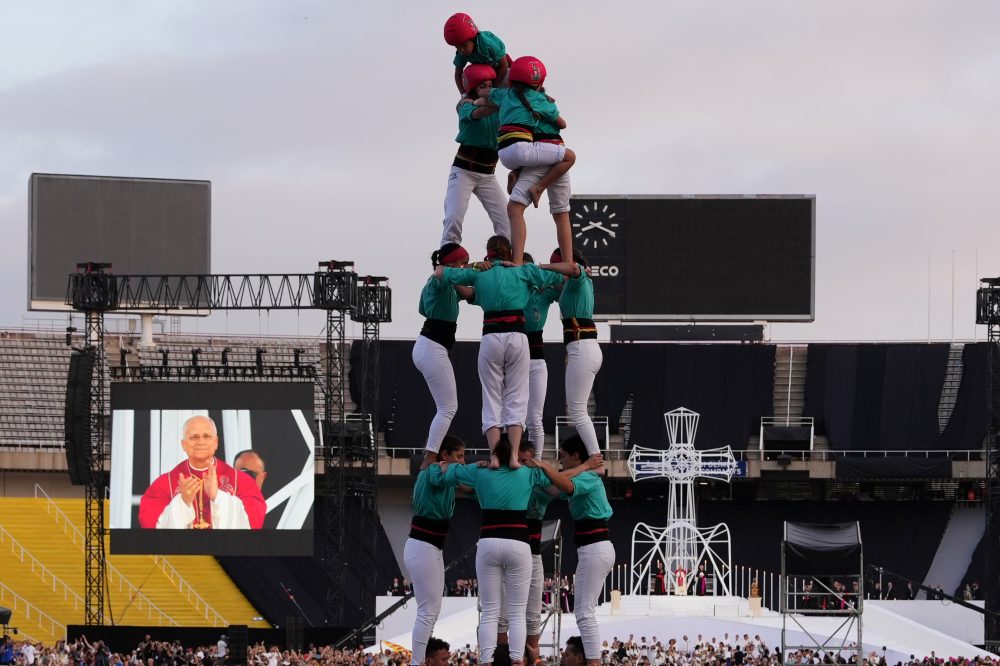

VILAFRANCA DEL PENEDES, Spain (AP) — Eight-year-old Bruna Vall Galán delivered an extraordinary greeting to Pope Leo XIV on Tuesday evening in Catalonia — perched atop a towering human formation stretching nearly 10 meters (33 feet) high during the pontiff’s prayer vigil in Barcelona.
These human formations, known as “castells” in Catalan, represent far more than displays of balance, power and cooperation — they embody the deeply-rooted cultural identity of this Spanish region in the northeast.
The Castellers de Vilafranca, among the most renowned groups maintaining this heritage, were selected to showcase their skills for the pope during his week-long Spanish visit. The Associated Press followed their experience from the lengthy bus journey through pre-performance nerves to the triumphant celebrations following Leo’s enthusiastic response.
“A fundamental richness of castells is that anybody can take part, independently of their age, their culture, their weight or height, their beliefs or ideologies,” said Ernest Gallart Pérez, the group’s president. “Every person has their place on the structure.”
Bruna’s mother, Maria Vall Camell, became a member at age 18 and eventually found her spouse within the organization, where participants wear distinctive jade green shirts, white pants, tight black sashes and red bandannas with white dots. These bandannas and sashes serve as essential grip points for members scaling up and down one another as the formation grows.
“The human towers are like the skyline of Catalonia,” Vall told the AP on the bus as more than 130 castellers traveled from their small town, Vilafranca del Penedes, deep in Cava wine country about 30 miles (50 kilometers) from Barcelona. “They are an identity, very important for our culture, and they represent very well our society, that we work together as a team.”
These formations serve as centerpieces of Catalan festivities, from patron saint celebrations to competitions involving hundreds of performers. Yet fundamentally, they constitute family customs handed down across generations.
“It’s union, family, strength,” said Aida Ibañez Sadurní, who participated in Tuesday’s tower with her father, Xavier Ibañez Sanz. “When we get everybody down, we hug each other crying, and it’s the biggest emotion.”
Months of preparation precede these brief construction moments, beginning with a substantial foundation of people packed shoulder to shoulder in compact circles, heads pressed against neighboring shoulders, arms locked together.
During Tuesday’s performance, smaller four-person teams ascended to form an initial standing circle, followed by additional climbers until Bruna — fulfilling her role as the “anxaneta,” the girl positioned at the peak — reached the summit and waved before descending.
Following the castell’s successful completion, Leo beamed widely as roughly 40,000 stadium attendees responded with stadium-level cheering.
“It’s a relief, I’m very happy, very joyful,” said Àngel Grau, the “cap de colla” or coach of the group, as the sweaty, cheerful group made their way back out to their buses and long ride home.
“There were a lot of people watching us from around the world, and whether you believe a lot or believe less, it’s such an occasion for pride for us.”