
SpaceX’s latest Starship test flight on Friday demonstrated sufficient advancement to maintain investor enthusiasm for Elon Musk’s anticipated $1.75 trillion public stock offering, despite the rocket’s reusability goals remaining incomplete.
The Starship vehicle plays a crucial role in reducing SpaceX’s launch expenses, growing its Starlink satellite operations — the company’s primary revenue source — and enabling future projects including space-based computing, orbital AI data-center satellite deployment, and human expeditions to the moon and Mars.
“SpaceX did not need perfection from this Starship flight. It needed proof that the upgraded vehicle is moving in the right direction, and that is largely what investors saw,” said Mark Vena, CEO at SmartTech Research.
The aerospace company has invested over $15 billion in developing what it anticipates will become a completely reusable rocket system capable of transporting significantly larger cargo loads than current launch platforms.
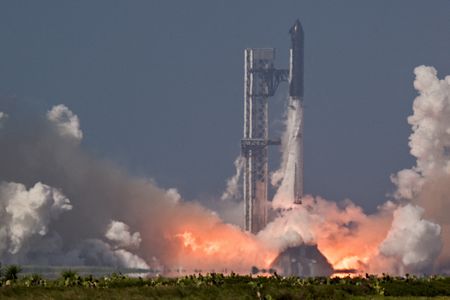
Friday’s test marked SpaceX’s 12th Starship prototype flight since 2023 and the inaugural launch of its V3 version, achieving success in most objectives. The vehicle successfully released a group of simulated satellites and performed a controlled ocean landing in the Indian Ocean. However, the mission fell short of achieving a controlled Super Heavy booster recovery, with the component crashing into the Gulf of Mexico.
According to Vena, even an incomplete test can enhance the investment appeal when it shows measurable advancement toward complete reusability.
Investment professionals, market analysts, and portfolio managers express strong optimism about the public offering, wagering that Musk, recognized for transforming risky engineering ventures into market-leading enterprises, will fulfill the ambitious commitments outlined in SpaceX’s public offering documents.
“Full reusability is the key to unlocking dramatically lower launch costs,” said James Bruegger, chief investment officer at British investment firm Seraphim Space. “That’s where the real value lies.”
The company has cautioned that development delays or cost overruns could impede the deployment of advanced satellites and AI infrastructure by increasing expenses, reflecting concerns from some investors that Starship might become caught in repeated repair cycles and new malfunctions, never fully demonstrating a complete operational system.
“What we saw with the Starship launch is that it reduced the bear case risk that the Starship is stuck in a failure loop. So it doesn’t completely eliminate the execution risk,” said Jesse Nacht, a research associate at MarketVector Indexes. “Unless something were seriously catastrophic, I don’t think it would change expectations all too much.”
Antoine Grenier, partner and head of space consulting at Analysys Mason, described the outcome as “lukewarm success” and possibly the optimal result.
“Total failure would have been problematic, total success would have triggered enormous IPO excitement,” he said.
Grenier noted that the seven-month interval since the previous test meant SpaceX needed to conduct a launch before the public offering because avoiding it “would have raised more questions” for investors assessing the company’s development timeline.
The investor presentation for the highly anticipated public offering is scheduled for June 4, and if completed successfully, the stock sale could generate up to $80 billion, establishing it as the largest in history.
Investment professionals increasingly view SpaceX beyond its launch and satellite operations, seeing it as a potential AI infrastructure provider.
On Tuesday, Musk supported xAI’s development path, emphasizing that the three-year-old company remains in early stages compared to competitors OpenAI and Anthropic, while promising that its models “will be great.”
Currently, market analysts indicate SpaceX remains far from demonstrating Starship’s ability to function dependably and cost-effectively at large scale.
“Obviously, SpaceX will need to demonstrate a successful launch, payload deployment, orbits and touchdown of the booster and the vehicle in order to enable deployment of the system at scale to construct a megaconstellation of orbital data centers,” said Austin Moeller, managing director of equity research at Canaccord Genuity.