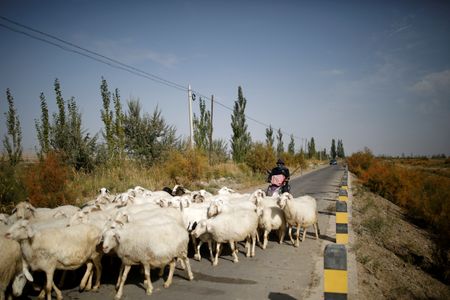

A Chinese farm owner never anticipated that his simple job posting for shepherd positions would become an internet phenomenon, attracting hundreds of desperate job seekers and highlighting the nation’s employment challenges.
Zuo Xiaoyong found himself overwhelmed when more than 700 people responded to his advertisement for just two shepherd roles. The applicants included office workers from major cities like Shanghai and Chongqing, factory employees from various regions, and recent college graduates.
The job listing, posted in late April, generated massive attention on Weibo, the Chinese equivalent of X, accumulating 59 million views in just hours and sparking over 21,000 discussion threads.
“I didn’t expect it to go viral,” Zuo commented, noting that one-tenth of those who applied were recent university graduates, while others were struggling with debt, demanding factory jobs, or workplace stress.
“It seems ordinary people are having a hard time finding work,” he observed.
The massive response reflects deeper issues in China’s employment landscape. Despite official unemployment rates remaining slightly above 5%, underemployment continues to climb, and private sector wages have failed to keep pace with economic expansion for nearly ten years. Workers in both blue-collar and white-collar positions frequently criticize the demanding ‘996’ work schedule – laboring from 9 a.m. to 9 p.m. six days weekly.
Economic experts predict worsening job market conditions in upcoming months due to rising factory costs from international conflicts, increasing artificial intelligence implementation, and a record-breaking 12.7 million university graduates entering the job hunt this summer.
Lynn Song, chief China economist at ING, described the reaction to Zuo’s advertisement as “symptomatic of what continues to be a highly competitive and often low-rewarding labour market.”
“Urban jobs are becoming less attractive and more rare,” Song added.
China’s 5% economic expansion depends significantly on booming exports, as manufacturers reduce profits to capture global market share, intensifying pressure on domestic workers.
Among the applicants was James Guo, who sought the position due to exhaustion from his container manufacturing job.
“You have no idea what it’s like to work more than 13 hours a day, fastening screws until your hands are swollen and covered in blisters, without even having time to go to the bathroom,” the 21-year-old explained. “The workload is too intense, I can’t take it anymore.”
Zuo’s job requirements involved managing 3,000 sheep across a 2,000-hectare pasture during summer months and handling demanding indoor feeding and cleaning tasks during harsh winters when temperatures plummet below minus 30 Celsius.
The compensation offered 8,000 yuan ($1,178) monthly per shepherd, exceeding the national urban private company average of approximately 6,000 yuan, plus provided housing and food.
Shaun Rein, managing director of China Market Research Group, noted that master’s degree holders from prestigious universities in Shanghai typically seek comparable salaries, but most earnings disappear on rent for cramped apartments and basic living costs.
Zuo, who also manages 200 cattle, emphasized that the generous pay reflects the job’s difficulties.
“The salary is high, but whether you can work long-term and get through the winter is what matters most,” Zuo stated. “This is not tourism.”
Half the applicants were born during the 1990s, representing an age group affected by what Chinese workers term the ‘curse of 35,’ as research indicates most employers, including government agencies, dismiss candidates exceeding that age.
“We are seeing the ‘curse of 35’ move from a tech-sector meme to a broader economic reality,” explained Christian Yao, senior lecturer in human resource management at Victoria University of Wellington.
Wu, a 28-year-old e-commerce employee who provided only her surname for privacy, earns 10,000 yuan monthly but found the shepherding opportunity appealing.
“I want to escape city life and stop dealing with all kinds of difficult people,” Wu shared. “I could enjoy a peaceful, secluded life away from the world.”
Ultimately, Zuo selected four shepherds – two married couples – all born in the 1980s with previous farming experience. While maintaining a waiting list of 40 additional couples, he refuses to consider unmarried individuals or young city dwellers.
“In our place, you might not see people for a whole year,” Zuo concluded. “Whether someone can endure such loneliness, I don’t know.”