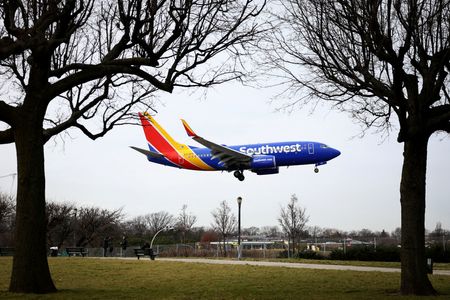

Southwest Airlines announced Saturday that Boeing’s troubled 737 MAX 7 aircraft won’t begin commercial flights until 2027, as the airline continues backing Boeing despite ongoing delays.
Chief Operating Officer Andrew Watterson shared the timeline during an interview at the International Air Transport Association’s annual conference in Rio de Janeiro. He emphasized that Southwest remains committed to Boeing’s MAX aircraft series instead of exploring alternatives like Airbus’s A220.
“Diversification doesn’t come through a second fleet type,” Watterson explained to Reuters. “A second fleet type can increase your risk.”
“It doesn’t make sense to lose focus on that,” he continued.
The MAX 7 continues waiting for approval from the U.S. Federal Aviation Administration. Once certified, Southwest plans approximately six months of internal preparation, including updating operating procedures and training materials.
“The clock starts when they certify it,” Watterson noted.
According to Watterson, the prolonged MAX 7 delays haven’t prevented Southwest from launching specific routes, but have hampered the airline’s ability to properly match aircraft capacity with passenger demand. The consequence involves operating larger planes when smaller jets would better serve certain markets or time periods with reduced demand.
Meanwhile, Southwest continues implementing Starlink-powered internet service, though Chief Customer and Brand Officer Tony Roach said the airline hasn’t eliminated Amazon’s Leo satellite network as an option.
Roach indicated Southwest anticipates having a Starlink-equipped aircraft operational this month. The airline aims to install Starlink on 300 planes by December, though the timeline depends on equipment delivery from Starlink.
“Our tech ops can retrofit as fast as Starlink can deliver,” Watterson stated.
Addressing criticism from activist investor Elliott Investment Management, Watterson acknowledged the company had been slow to implement changes, despite ongoing improvement efforts.
“What Elliott was unequivocally correct about is we were too slow,” he admitted.
Watterson believes investors have undervalued Southwest customers’ appetite for new services, suggesting revenue per available seat mile will serve as the “litmus test” for measuring the success of company changes.