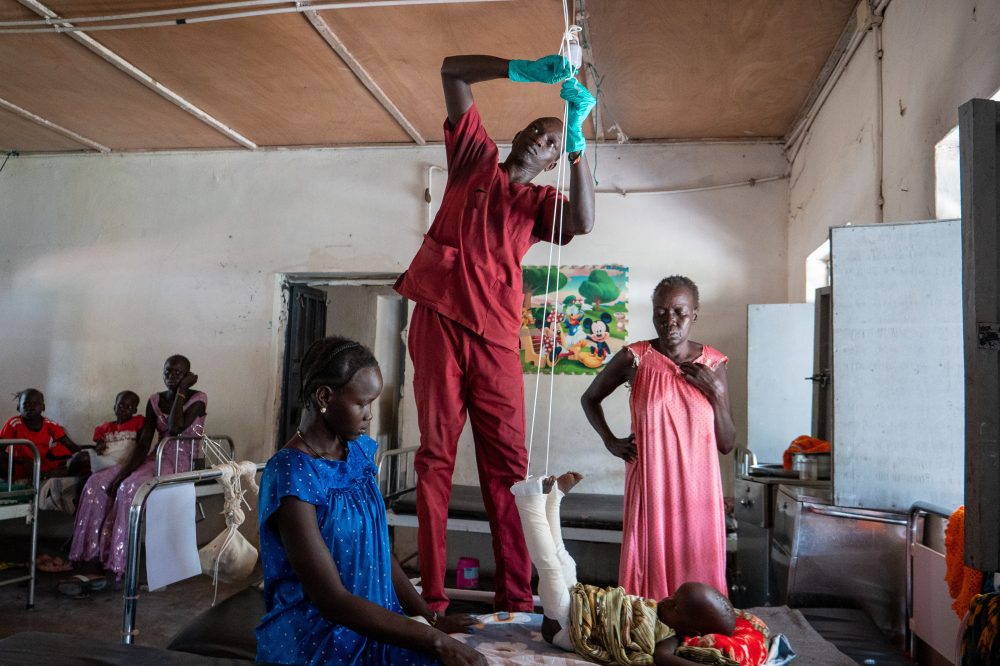

AKOBO, South Sudan — In a hospital bed in South Sudan’s northeastern region, 18-month-old Kool Gatyen Pajock received medical treatment as his grandmother Nyayual Chuol watched healthcare workers tend to his wounded legs.
According to Chuol, government soldiers shot the toddler and murdered his parents before she carried him 80 miles from their village to seek medical help in Akobo, near the Ethiopian border.
Their story represents just a fraction of the 280,000 individuals forced from their homes over the past two months due to escalating violence in Jonglei state between government military forces, called the South Sudan People’s Defense Forces, and opposition fighters from the Sudan People’s Liberation Movement In Opposition.
“I have nothing in my hand now to take care of this baby,” Chuol said. “I’m worried about my four children who ran in different directions when the attack took place. I don’t know where they are now.”
The current violence puts at risk a delicate peace accord established in 2018 following five years of civil warfare.
Under a 2020 power-sharing deal, opposition leader Riek Machar became first vice president serving with President Salva Kiir. However, Kiir detained Machar at his residence after fresh violence erupted in March. Authorities charged Machar with treason in September along with seven other opposition figures connected to an assault on government troops.
Tensions intensified in December when opposition fighters captured government positions in Jonglei. Since January, government forces have launched a counterattack using air strikes and ground operations, even while officially supporting the peace deal.
Beyond displacement, ordinary citizens have endured substantial casualties.
“People are still fearing that the government army may come and attack here,” Chuol said. “This is what is worrying me right now.”
Twenty-eight-year-old Nyankhiay Gatluak Jock fled her village of Walgak following a government assault in early February.
“They bombed us from the gunship helicopter, and after that the soldiers came with their cars and started shooting,” said Jock, who joined 42,000 displaced individuals seeking shelter in Akobo under United Nations Mission protection.
“We want to ask the president to tell his army to differentiate between the combatants and the civilians,” Jock said while nursing two children in a church where other displaced women and young people had gathered.
Following government forces’ bombing of a Doctors Without Borders medical facility on February 3rd, Nyaphan Nyang Lual traveled toward Akobo with her husband, daughter and one-month-old granddaughter. During their journey, gunmen killed her husband and kidnapped her daughter.
Lual arrived in Akobo with granddaughter Bhan Tut Mut but couldn’t locate food aid and feared for the infant who had developed severe diarrhea.
“We took her to the clinic but there is no medicine there, and I cannot afford to buy from the pharmacy,” Lual said.
Aid organizations have also suffered attacks. The United Nations Office for the Coordination of Humanitarian Affairs reported that 13 medical facilities in Jonglei were “looted or partially destroyed.” Accounts of extensive sexual violence have also surfaced.
Budget reductions and government limitations on relief organizations have created shortages of resources and supplies, according to aid workers who expressed frustration about their inability to provide adequate assistance.
“We have nothing … no feeding, no medication,” said Susan Tab, a reproductive health officer in Akobo with Nile Hope, a South Sudanese organization. “The only thing we can provide to help these displaced people is psychosocial support.”
UN humanitarian chief Tom Fletcher traveled to Akobo on February 21st as part of a tour through South Sudan’s conflict-affected regions.
With nearly three years of civil conflict in northern Sudan and fighting in neighboring Horn of Africa nations, Fletcher described South Sudan as “one of the most neglected crises in the world right now.”
“I want to make this crisis more visible to the public. And I want them to demand change. To demand funding. To demand political engagement to end this war,” Fletcher said.
Thousands of displaced women and children welcomed him in Akobo, though they remained uncertain about their safety and prospects. Some carried signs with handwritten pleas, including one with the stark message, “They killed everyone.”
“Help is coming,” Fletcher assured the survivors.