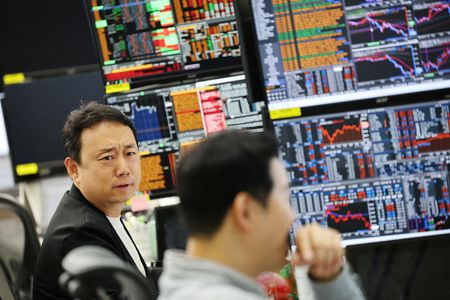

After 18 years trading currencies in Seoul, Namkoong Taehun has witnessed some of the most turbulent moments in global finance — the collapse of Lehman Brothers, the pound’s freefall following Brexit, and the South Korean won’s sharp decline after the country’s 2024 martial law decree.
Now, the 47-year-old faces what he calls his most daunting challenge yet: a shift to round-the-clock trading as South Korea prepares to open its long-restricted currency to a full 24-hour trading cycle beginning July 6. Banks began trialing the system Monday.
“When I first came to the market, it was a 9-to-3 game,” said Namkoong, who works on the 37-member foreign exchange trading team at Hana Bank in Seoul, the country’s largest forex bank by trading volume. “You could count the participating financial institutions on one hand.”
Surrounded by a dozen empty coffee cups and eight monitors displaying currency conversion orders, he added: “Now, the market has expanded exponentially. I’m seeing a significant increase in demand for won assets based on the many financial institutions that are inquiring about them. We are afraid that our workload will increase significantly.”
The move represents a complete reversal from South Korea’s approach three decades ago, when strict currency controls were put in place following the won’s collapse during the 1997 Asian Financial Crisis. Today, an open and accessible currency is considered essential for South Korea’s bid to earn index provider MSCI’s prestigious “developed market” designation — a status that would significantly boost the country’s appeal to global investors.
However, the transition carries real dangers. The won is already hovering near a 17-year low against the U.S. dollar, leaving it exposed to periods of thin trading activity that could amplify even modest currency flows into dramatic price swings.
Adding to the pressure, South Korea’s benchmark KOSPI share index has surged to record highs this year — a development that is paradoxically weakening the won, as overseas funds cash in on their gains or restructure their portfolios. Meanwhile, South Korean investors continue to pour money into U.S. stocks at an unprecedented rate.
To help manage the risks that come with around-the-clock trading, the government has introduced a series of safeguards. These include allowing offshore investors to hold and trade the won directly, establishing an offshore won settlement system, and implementing an overdraft policy.
“Previously, foreign financial institutions were only able to convert money,” said a government official overseeing foreign exchange policy. “But through the offshore won settlement system, they will be able to directly hold and utilize the won.”
For years, South Korea’s tight currency restrictions have frustrated investors and traders, forcing them to rely on complex derivatives contracts to manage their won exposure outside of regular trading hours. It was only two years ago that South Korea extended won trading hours to 2 a.m. to capture activity during the London market session.
“Roughly 20% of the spot volume now takes place during offshore hours, concentrated in the London morning,” said Shen Li, head of FX sales for APAC at State Street Hong Kong. “The extension to 24 hours could further enhance this whole liquidity scheme.”
The broader objective is to eliminate what is known as the “Korea Discount” — the persistent tendency for South Korean stocks to trade at lower valuations than their global counterparts, due in part to currency restrictions, unpredictable policymaking, and murky governance at the country’s powerful “chaebol” conglomerates.
However, MSCI announced Wednesday that it is keeping South Korea in the emerging market category, pointing to longstanding accessibility concerns and saying that onshore liquidity remains insufficient even with the extended trading hours. The next review is scheduled for one year from now.
In the meantime, banks are gearing up for the new reality by hiring additional staff and restructuring work schedules. Hana Bank, which already operates a three-shift system, plans to bring on three more employees. Woori Bank will double its London-based team to four people, Shinhan Bank will add one staff member in London, and KB Kookmin Bank has already added two.
The intensity of constant market monitoring was made clear to 35-year-old Hana Bank FX dealer Shin Jae-min, who described a recent surge in activity near the end of his shift. “Sometimes it gets intense all of a sudden, like the other day when orders flooded in after SpaceX went public,” he said while eating a delivery chicken kebab around 9 p.m. “Responding to such demand means no break even during some really odd hours.”