
Cities across South Africa ground to a halt on Tuesday, with workers staying home, storefronts locked up, and public buses sitting empty, as anxiety grew that planned anti-immigrant demonstrations could turn violent.
Many immigrants from other African nations chose not to go to work, and thousands more had already packed up and left ahead of a deadline imposed by the protest organizers — a cutoff by which all undocumented migrants were told to be gone.
Most foreign nationals have taken that deadline as a direct physical threat. Historically, xenophobic demonstrations in South Africa have erupted into violent attacks on immigrants and their belongings, with little regard for whether those targeted entered the country legally or not.
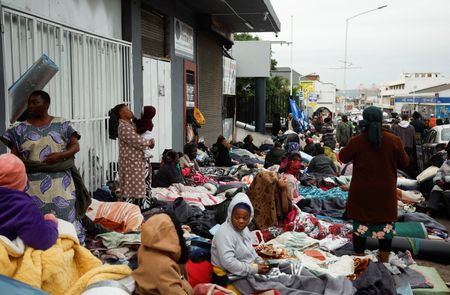
In both Johannesburg, the country’s main city, and the port city of Durban, witnesses reported that landlords were forcing foreign tenants out of their homes, fearing their properties would be destroyed.
Standing near a group of roughly 100 people sleeping outside on a downtown Durban street, Mabako Majole, a leader within the Congolese community, described what was happening to those around him.
“All these people, they were chased out by their landlords,” Majole said. “All these people are legal. They have documents.”
Law enforcement officers and military personnel were sent into the streets of multiple cities to try to maintain peace during the marches, which were expected to draw large numbers of mostly low-income or unemployed South Africans.
“The state has the duty and obligation to ensure that those that are demonstrating do so peacefully,” Deputy National Commissioner for Policing Tebello Mosikili said at a news conference held Monday evening.
The wave of anti-immigrant sentiment, combined with what critics describe as a failure by police to protect attack victims, has damaged South Africa’s post-Mandela image as a champion of human rights and has put a strain on its relationships with neighboring African nations.
Several politicians have voiced sympathy with the demonstrators’ concerns, even while speaking out against violent behavior.
President Cyril Ramaphosa addressed the situation in a Monday statement, acknowledging the frustrations of South Africans while drawing a firm line. “South Africans’ … deep concerns about illegal immigration … are real and they deserve to be heard,” he said. “But the right to protest … does not allow people to threaten or intimidate others, or to engage in acts of vandalism or violence.”