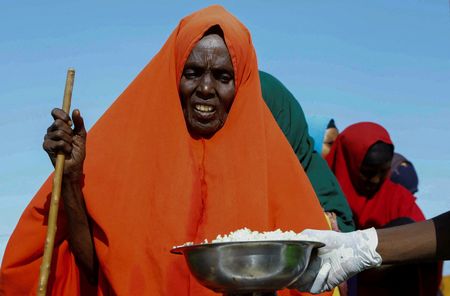

MOGADISHU – Somali authorities and United Nations officials announced Tuesday that approximately 6.5 million residents are experiencing severe hunger as the country’s devastating drought crisis continues to worsen.
The alarming announcement comes just days after the UN’s food assistance program warned that critical aid distributions could cease by April due to insufficient funding.
Somalia’s government officially declared a drought emergency in November following consecutive seasons of inadequate rainfall, a pattern that has also devastated neighboring nations throughout the region.
According to a joint declaration from Somalia’s administration and UN Somalia, children represent more than one-third of those suffering from severe malnutrition. The humanitarian disaster has displaced tens of thousands of families, many of whom have sought shelter in overcrowded camps throughout Mogadishu and other urban centers.
“The drought … has deepened alarmingly, with soaring water prices, limited food supplies, dying livestock, and very little humanitarian funding,” George Conway, the U.N.’s Humanitarian Coordinator for Somalia, said in a statement.
Hawo Abdi, who lost two children to disease after drought devastated her community in Somalia’s Bay region, described her desperate journey to the capital.
“When I saw that the suffering was getting worse, I fled my home and came to … Mogadishu,” she told Reuters from her shelter on the outskirts of the capital.
The World Food Programme reported last week that 4.4 million Somalis were experiencing acute hunger, while also announcing significant cuts to their assistance programs – reducing aid from 2.2 million recipients earlier this year to just over 600,000 people currently.
Officials have not clarified whether the updated 6.5 million figure represents a dramatic surge in those at risk or reflects different assessment methodologies.
The statistics released by Somalia’s government and the United Nations align with data published Tuesday by the Integrated Food Security Phase Classification, the international organization that establishes global standards for measuring food crisis severity.
Although anticipated rainfall between April and June may provide some relief, projections indicate that approximately 5.5 million people will continue facing crisis-level conditions or worse, with 1.6 million experiencing emergency-level hunger, according to the joint statement.
Abdiyo Ali, who was compelled to leave her agricultural land in the Lower Shabelle region, described the complete destruction of her livelihood.
“Our farms were destroyed, our livestock died, and water sources became too far away. We have nothing left to bring with us,” Ali told Reuters last week while preparing her food in a displaced people’s camp outside Mogadishu.