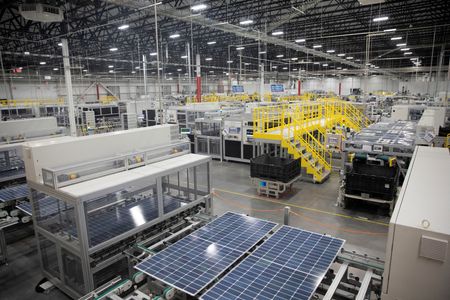

Solar energy developers nationwide are racing against the clock, rushing to secure federal subsidies before a July 4 cutoff that could dramatically increase the cost of renewable power for years to come.
The urgency stems from the phaseout of clean energy tax credits under President Donald Trump’s 2025 tax law — subsidies that have been in place for two decades and cover at least 30% of project costs. Once those credits disappear, analysts expect contract prices for wind and solar power to jump between 40% and 50%. Early figures out of Texas are even more alarming, with some deals already showing price increases of 120%, according to an analysis by energy firm LevelTen Energy.
President Trump has long maintained that wind and solar power are overly expensive, benefit from unfair government support, and are less dependable than fossil fuels because they rely on natural conditions. The White House did not respond to a request for comment on the tax credit changes.
Despite the looming deadline, the rush to qualify for credits has created an enormous backlog. Energy research firm Wood Mackenzie reports that more than 200 gigawatts of solar capacity has effectively secured tax credit eligibility — a figure that represents nearly double the entire current U.S. solar fleet. Solar remains the fastest-growing source of electricity in the country.
Developers have been using a strategy called “safe harboring” to preserve their eligibility before the July 4 cutoff. This can involve beginning construction at a site, purchasing major equipment, logging worker hours, or spending a set portion of project costs. Once those steps are taken, developers have four years to finish building the facilities — though many are still looking for buyers for the power those projects will generate.
“It should give caution to folks that are waiting on the sideline,” said Connor Valaik, a senior manager at LevelTen, which connects renewable energy sellers and buyers. “The future is not the rosiest with this tax credit cliff.”
Even so, some developers are finding reasons for optimism. Because electricity prices are already climbing sharply — driven largely by surging demand from data centers and artificial intelligence — renewable energy may still be cost-competitive even without the subsidies.
“We can initiate projects… at the same level of profitability in three years that we can today, because the price of energy has already escalated so dramatically in the areas that we’re doing business in, with no sign of slowing down,” said John Witchel, CEO of Durango, Colorado-based commercial solar developer King Energy.
Revel Energy, a commercial solar developer based in Irvine, California, has secured tax credits for roughly 10 projects, though the company typically completes 15 per year. Tyler Crossno, the company’s digital marketing manager, noted that customers going solar without the tax credit will likely take five to six years to break even on their investment, compared to about three years under current conditions.
A 2025 analysis by investment firm Lazard found that even without subsidies, large-scale solar and onshore wind remain the least expensive forms of electricity generation. Community and industrial solar installations are also cost-competitive with natural gas and nuclear plants.
The large pipeline of already-approved projects is expected to keep U.S. solar installations strong through the end of the decade. However, energy policy research organization Energy Innovation forecasts that new large-scale capacity will begin to shrink in the early 2030s.
“That is inevitably going to drive prices up,” said Jake Schueller, a partner with Woven Energy, which helps tribes develop energy assets.