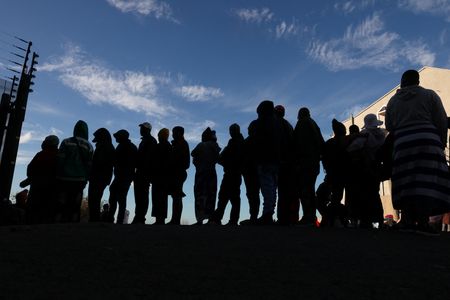

Tensions are running high in South Africa as an anti-immigrant movement has given undocumented foreigners until Tuesday to leave the country, with large-scale rallies expected that many worry could turn violent.
Thousands of African migrants have either begun making their way home or are sheltering together in makeshift camps out of fear of being attacked. The group organizing the demonstrations, called March and March, insists its actions are peaceful.
Here’s a closer look at what’s driving the protests, how widely shared these views are among South Africans, and whether the claims being made actually hold up to scrutiny.
What Are the Protesters Angry About?
Groups opposed to immigration argue that South Africa has been overwhelmed by undocumented foreigners who are stealing jobs, draining public resources, and driving up crime. On June 24, Musa Hlongwa, president of the anti-migrant civil group United South Africa, addressed reporters directly on the issue.
“South Africans are tired of standing in long queues in hospitals … competing for spaces in public schools with illegal immigrants … competing for jobs with foreign nationals … tired of Nigerians who are selling drugs to youth of this country,” Hlongwa said.
How Many South Africans Feel This Way?
Three separate surveys conducted last year all pointed to a growing wave of anti-immigrant feeling in the country. A Human Sciences Research Council poll found that hostility toward immigrants has reached record levels — only one in six adults said they would welcome all foreigners, while 42% said they would welcome none at all, a jump from one-third who held that view in 2021.
An Afrobarometer survey revealed that seven out of ten South Africans view immigrants’ economic impact as harmful, and a striking 85% believe authorities should reduce or completely halt the number of refugees entering the country. Meanwhile, an Ipsos poll found that nearly three-quarters of respondents said they did not trust African immigrants “at all.”
Do the Claims Hold Up?
Claim 1: South Africa Is Being Overrun With Illegal Immigrants
According to a 2023 national statistics office survey, there were 3.1 million migrants living in South Africa — roughly 4.1% of the total population, actually down from 5.6% a decade earlier. By international comparison, that figure is relatively low: the United Kingdom’s migrant share stands at 17%, Canada’s at 22%, and Australia’s at 30%, based on 2024 United Nations data.
While some campaigners argue the official numbers undercount undocumented arrivals, StatsSA uses census methods specifically designed to capture those individuals as well.
“The impression is that there are … hordes of people coming into the country, but the data points to the contrary,” said Anthony Kaziboni, a senior researcher at the University of Johannesburg’s Centre for Social Development in Africa.
Claim 2: Foreigners Are Behind South Africa’s High Crime Rate
Police in South Africa do not publish data on the nationalities of convicted criminals. However, justice department prison figures from 2017 showed that 11,842 foreign nationals were held in South African prisons — about 6% of the total prison population. Of those, 1,380 were incarcerated specifically for illegal entry into the country.
“All evidence suggests immigrants are disproportionately law abiding. Most of their crimes are immigration violations,” said Loren B. Landau, Professor of Migration and Development at the University of Oxford.
Claim 3: African Migrants Are Taking Jobs From Locals
A 2018 World Bank report found the opposite to be true — for every migrant who finds employment, approximately two jobs are created for South African workers through the resulting business activity. That’s because migrants earn wages and then spend most of that money locally on goods and services.
“If you own a restaurant in South Africa … (you) have more customers available to you,” said Lauren Gilbert, director of political science data at GeoQuant. “If migrants are living with dubious kitchen facilities (for example) because migrant housing is often bad … they’re more likely to eat street food.”
Claim 4: Undocumented Migrants Are Draining Public Services
Kaziboni noted that undocumented migrants are very unlikely to use public hospitals or schools — both of which require registration — out of fear of being identified and reported. Economists point to chronic underinvestment and widespread corruption as the real culprits behind the country’s struggling health and education systems.
“To squarely blame immigrants for a failed healthcare crisis is unjust and it’s unfounded. There is no evidence that supports that,” Kaziboni said. “We should blame poor governance, maladministration and corruption,” he added, pointing out that 1.5 trillion rand ($91.27 billion) was lost to corruption during former president Jacob Zuma’s time in office, with an additional 1 billion rand spent just to investigate it.
So Why the Deep-Rooted Hostility?
Historically, the apartheid government relied on migrant labor from across Africa to suppress wages in gold mines and weaken labor unions — a legacy that has left a lasting mark on the national consciousness. Today, one in three South Africans is unemployed, one of the highest rates anywhere in the world. Poor public service delivery contributed to the ruling African National Congress losing its parliamentary majority in 2024 elections, and inequality remains among the worst globally by some measures.
Those conditions create fertile ground for frustration that often gets redirected toward migrants. Politicians have also been known to fan those flames, particularly around election season — and local elections are expected by November of this year.
“Immigrants are by no means the reason why services and the economy have faltered, but people remember what confirms their biases,” Landau said. “What they don’t see is the foreigners investing, trading or providing skills the economy needs.”