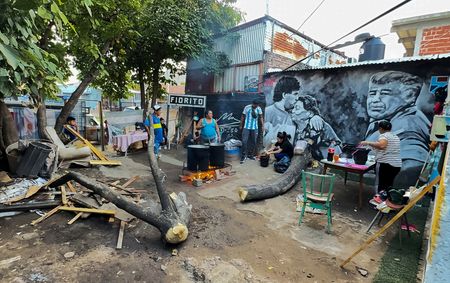

Weekly, hundreds of residents queue up with plastic containers to receive meals at an extraordinary location: the modest childhood residence of soccer icon Diego Armando Maradona in Argentina.
Located in Villa Fiorito, an impoverished area outside Buenos Aires, the property no longer belongs to Maradona’s relatives following his 2020 death from cardiac arrest. For the past month, the current property owner has allowed volunteers to use the dirt courtyard to grill and prepare meals for local residents.
During a recent Thursday visit, Maria Torres was seen preparing stew in two oversized pots while other volunteers prepared potatoes and cut up chicken portions. The building’s front wall features a painted mural showing the soccer star alongside text reading “The house of god.”
Argentina’s poverty statistics show improvement, declining to 31.6% during the first six months of 2025 from 52.9% in early 2024, when President Javier Milei dramatically devalued the currency and inflation surged. Officials plan to release second-half 2025 data on Tuesday.
Despite this “very important drop” in poverty levels, Argentina requires increased GDP expansion in job-creating industries like mining rather than capital-focused sectors such as farming, according to Eduardo Donza, a sociologist from Argentina’s Catholic University.
The poverty reduction coincided with significant decreases in monthly inflation rates, falling from double-digit levels when Milei assumed office to 2.9% by February.
Nevertheless, Milei’s budget-cutting policies have drastically reduced government employment, and many citizens report decreased buying power following reductions in transportation and energy assistance programs.
Pastor Leonardo Fabian Alvarez, who operates the temporary food distribution site, reports increased demand for meals in Villa Fiorito and surrounding areas as small manufacturing businesses have shut down. Milei’s deregulation policies and a strengthened peso have made foreign goods more affordable.
“People obviously lost their jobs,” Alvarez explained, noting that “they come to the line, pick up food, take what we give them.”
In 2021, Argentina officially designated Maradona’s birthplace as a national historic landmark.