
NEW DELHI — It started with just six words typed out in a moment of frustration on the social media platform X: “What if all cockroaches come together?”
Those words, written by 30-year-old political communications strategist Abhijeet Dipke on May 16, have since helped ignite what many observers are calling the largest street demonstrations against Prime Minister Narendra Modi’s government since he came to power in 2014.
Dipke’s post was originally a sharp-tongued response to remarks made by a Supreme Court judge, Surya Kant, who had compared India’s unemployed young people to “cockroaches” during a public speech. Kant later said his words had been taken out of context.
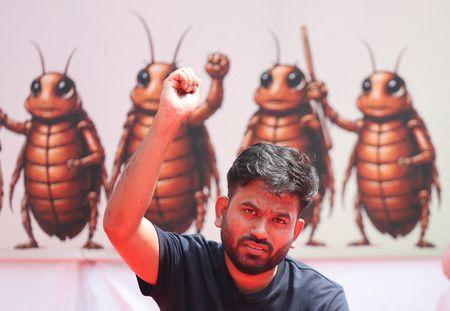
But by that point, the post had already spread rapidly across the internet. A satirical political group called the “Cockroach Janta Party,” or CJP, emerged from the moment, becoming a gathering point for millions of young Indians fed up with high unemployment, leaked exam papers, and what they see as a lack of government accountability.
Over the past three days, tens of thousands of people have flooded into New Delhi, calling for the resignation of Education Minister Dharmendra Pradhan. Their anger centers on the leak of a medical college entrance exam that affected approximately 2 million students in May — a scandal that has also been connected to multiple student suicides.
Scattered protests have also broken out in other cities across the country, including the financial center of Mumbai.
At the heart of the movement stands Dipke himself.
Roots in Humble Beginnings
Until early June, Dipke had been living in the American city of Boston. He flew back to India to launch a protest near the Jantar Mantar observatory in central Delhi.
Since his return — and especially after a police crackdown on protesters on Monday drew widespread public anger — Dipke has been a constant presence on a raised platform at the demonstration site. Bearded and typically dressed in a T-shirt and jeans, he speaks to crowds of hundreds, urging calm while keeping pressure on the government.
Although the CJP has multiple organizers, Dipke has become its most recognizable figure, attracting both supporters and critics. Last week, a woman hurled blue ink at him while he was addressing the crowd, staining his face. She later claimed the CJP had shown disrespect toward Lord Ram, a major figure in Hinduism.
Dipke grew up in Aurangabad, in the western Indian state of Maharashtra, born into a Dalit family — one of India’s most historically marginalized communities.
“My father comes from a very humble background. He grew up in extreme poverty. My grandfather was just a farmer,” Dipke told Reuters during a phone interview from Chicago in May.
His identity as a Dalit has long influenced his political outlook. When he arrived in Delhi on June 6, he held up a copy of “My Autobiography” by B.R. Ambedkar — a celebrated champion of Dalit rights and a principal architect of India’s democratic constitution — as supporters and security personnel crowded around him.
Following the ink incident, Dipke shared a video of what happened with the caption: “Blue is my colour” — a phrase widely understood as a nod to the color associated with the Ambedkarite movement.
In 2020, Dipke joined the social media team of the Aam Aadmi Party, where he said he honed a style of political communication built on memes, humor, and satire. He is no longer connected to that party, though it and several other opposition parties have expressed support for the current movement.
In 2023, Dipke relocated to the United States to pursue a graduate degree in public relations in Boston, while continuing to closely follow events in Indian politics.
From a Single Post to a National Movement
Dipke himself says he is still trying to come to terms with how prominent he has become.
One of the earliest people to help amplify the movement was a Delhi-based YouTuber named Meghnad S. Shortly after Dipke’s original post, Meghnad and a friend used artificial intelligence tools to create a satirical website announcing the founding of the Cockroach Janta Party.
“I saw the page and thought it was damn hilarious,” Meghnad said.
The movement’s Instagram account gathered 22 million followers within just a few days, eventually climbing to 25 million. “That’s how organic it was,” Meghnad added.
As the online momentum built, so did the real-world consequences.
Speaking to Reuters from Boston in May, Dipke described his goals: “This is a movement to change the political discourse of India. The youth of India has largely vanished from the mainstream political discourse.”
Despite receiving threats directed at both himself and his family, Dipke chose to return to India, saying he intends to remain until the affected students receive justice.
Since June 6, he has stayed at the protest site as the crowds have grown, frequently seen encouraging demonstrators to remain peaceful, speaking with journalists, or catching brief moments of sleep.
Addressing his supporters from the stage on Wednesday, Dipke was direct: “Let me make it clear — we will also not stop until we win.”