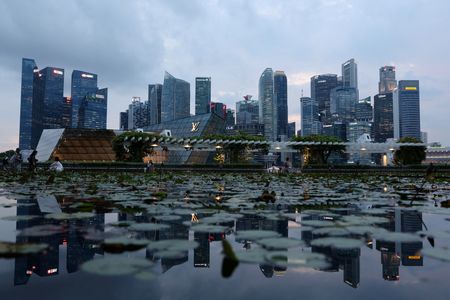

The island nation of Singapore is evolving into a technological safe haven as artificial intelligence companies seek refuge from the escalating tech battle between the United States and China.
Rather than serving as a bridge between East and West, Singapore has become a strategic location where businesses can distance themselves from both superpowers’ increasing control over technology exports and talent movement. The city-state’s business-friendly environment and English-speaking workforce make it an attractive alternative.
Kerry Goh, who leads Kamet Capital, explained that establishing operations in Singapore “gives a lot of comfort” to global customers because intellectual property remains on the island, free from regulatory interference by either China or the United States.
Goh recently counseled two former Alibaba executives who wanted funding to launch their AI video company Topview in Singapore, anticipating that international clients would be hesitant about Chinese government supervision.
“Your clients are not Chinese. This product is not available in China,” Goh noted about Topview, explaining that a Singapore base improves prospects for American sales. The company has secured more than $8 million from Kamet since 2024.
The tech rivalry between the superpowers intensified during Donald Trump’s presidency, with security concerns driving reciprocal restrictions that have accelerated with artificial intelligence development. Trump’s changes to H-1B visa requirements for skilled workers have particularly disrupted companies that regularly transfer employees to or from the United States.
These developments have strengthened Singapore’s goal of becoming the world’s most AI-driven economy through programs including specialized visas for AI professionals and tax incentives for intellectual property registration.
According to an Economic Development Board representative, these “ecosystem enablers” have drawn investment from companies of varying sizes and locations.
“Singapore is increasingly becoming a neutral hub for AI companies from both the U.S. and China,” observed Brad Gastwirth, who heads global research at Circular Technology.
Companies with Chinese or American connections now operating in Singapore include automation platform Workato, wealth management developer Addepar, and note-taking device creator Plaud AI. Legal platform Harvey AI established operations there in June.
American AI developer Anthropic, which raised $30 billion in funding led by Singapore’s sovereign wealth fund GIC, intends to open a Singapore office, according to three sources familiar with the plans. This would put the company alongside major players OpenAI, Meta’s Superintelligence Labs, and Google’s DeepMind. Anthropic representatives declined to provide comment.
However, Singapore’s appeal as a neutral zone could potentially trigger restrictions from the competing superpowers. The United States has already banned Nvidia from selling advanced AI chips to China and blocked access to semiconductor manufacturing equipment.
China reportedly imposed travel restrictions on founders of AI startup Manus after the company relocated from China to Singapore last year before being acquired by Meta. Similarly, China allegedly prevented MiroMind from sending employees overseas after the startup left China and established offices in Singapore, Japan, and the United States.
When contacted by reporters, MiroMind’s parent company Shanda only stated that it develops AI projects internationally. Shanda CEO Chen Tianqiao wrote on LinkedIn that global expansion proves challenging for AI companies when “regulation, geopolitics, and public scrutiny are changing faster than most companies can adapt.”
Neither China’s Ministry of Commerce nor the U.S. Department of Commerce responded to requests for comment.
National University of Singapore political scientist Chong Ja Ian warned that “given increasing demands from the U.S. and Chinese governments to keep their tech stacks separate, there is a risk that Singapore is seen as a grey space for technology transfers – including people moving to new firms – that one or both major governments disallow to take place.”
“That could result in restrictions being placed on Singapore,” Chong added.
Tan Yinglan, founding managing partner of Insignia Ventures Partners, noted that Chinese founders can only successfully establish Singapore operations if they surrender their Chinese citizenship, avoid employing engineers in China, and ensure their company’s revenue, data, and headquarters remain outside China.
The challenges facing technology companies operating between the two superpowers are extensive. China’s requirement that companies provide data upon government request concerns foreign partners, while unpredictable U.S. policies keep investors anxious.
“The (U.S. visa) process has become more unpredictable with longer processing times, stricter screening, and higher fees, which makes planning harder for startups and mid-sized AI companies that rely heavily on global talent,” Gastwirth explained.
Singapore’s entry process is “very friendly” with work permits sometimes approved within three days, according to Huang Lin, who founded corporate services provider Link-da. His company has assisted approximately 50 Chinese AI-related businesses in establishing Singapore operations since 2024.
Indonesian AI engineer Vincent Tatan described Singapore as “very welcoming” when he relocated there from the United States, where his employer had initiated but then canceled his permanent residency application.
“I can fight for it, but is it worth the fight and the wait?” Tatan questioned.