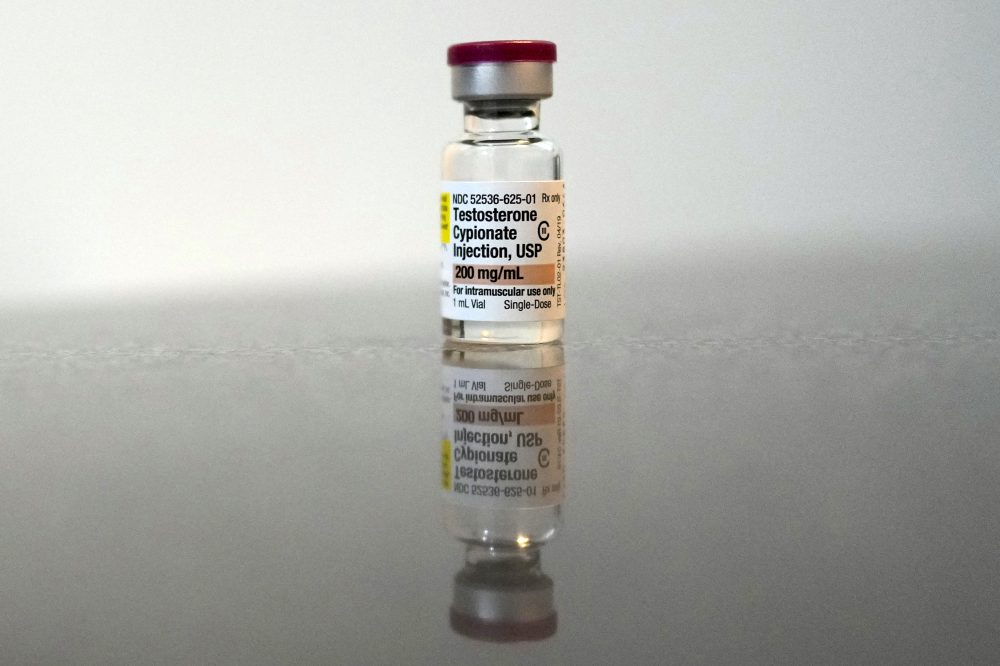

WASHINGTON — The Trump administration is moving to make it easier for men to obtain testosterone prescriptions, the latest chapter in a long-running debate over the hormone’s benefits and potential risks for sexual health, mood, and overall well-being.
Health Secretary Robert F. Kennedy Jr. and other senior officials are backing the effort. On Tuesday, Defense Secretary Pete Hegseth announced that the military would begin screening service members for low testosterone and offering the hormone as a tool to help troops perform at their “absolute best.”
While online influencers and men’s health podcasters have long promoted testosterone as a cure-all for building muscle and boosting energy, science does not support that sweeping claim. However, medical experts say a decade’s worth of new research has strengthened the argument for testosterone’s role in sexual health while reducing fears about cardiovascular risks.
“Many providers have been trained for years that these were real issues, and they were scared to get a testosterone reading from a patient or offer them testosterone therapy,” said Dr. Justin Dubin, a urologist at Baptist Health Miami Cancer Institute.
Last year, the Food and Drug Administration removed a prominent safety warning about potential heart risks associated with testosterone pills, gels, injections, and patches, citing updated data showing no increase in such problems.
Last month, the agency proposed revising prescribing instructions to allow testosterone to be used for age-related symptoms such as low libido and erectile dysfunction. The current label states the hormone is only approved for abnormally low testosterone caused by serious medical conditions or injury.
Doctors who prescribe the drug say patients with those specific conditions represent only a fraction of those seeking treatment.
“The majority of people we see in our office are regular men complaining of these common symptoms because they’re dramatically affecting their quality of life,” said Dr. Helen Bernie, a urologist and director of sexual health at Indiana University.
Testosterone was first approved in the 1950s to treat hypogonadism, a condition in which low hormone levels result from problems affecting the testes or other organs. Testosterone naturally decreases with age, which can affect sexual function, mood, and bone density — but how to properly diagnose and treat men with those issues has long been a subject of debate among researchers.
“These symptoms overlap with symptoms of human aging in men, so there’s a high risk of misdiagnosis and that’s led to the controversy,” said Dr. Shalender Bhasin of Harvard Medical School, who has co-authored several recent testosterone studies and treatment guidelines.
Bhasin notes that growing acceptance of men’s sexual health as a serious medical concern — a shift that began with the introduction of Viagra for erectile dysfunction in the 1990s — has contributed to increased willingness to prescribe testosterone.
Bhasin helped write the Endocrine Society’s current guidelines, which recommend discussing testosterone therapy with men who have documented symptoms and two blood tests confirming low hormone levels. A recent study by Michigan researchers found that only 12% of men receiving a prescription actually met that standard.
The risk of overprescribing is not new. In the early 2010s, pharmaceutical companies spent heavily on television advertising for testosterone gels, patches, and other products, marketing them as solutions for fatigue, muscle loss, brain fog, and weight gain. By 2013, those products were generating more than $2 billion in annual sales, even though most of the conditions advertised were not FDA-approved uses.
In 2015, the FDA responded by requiring drugmakers to clarify that their products were not approved for routine age-related complaints and to add a boxed warning about potential heart risks.
The FDA now says more recent evidence justifies relaxing those restrictions. A study mandated by the FDA and published in 2023 tracked 5,000 men with a history of heart disease — half received daily testosterone gel, and the other half received a placebo. After two years, there was no difference in rates of heart attack, stroke, or related complications between the two groups.
A separate series of National Institutes of Health studies involving nearly 800 older men found that testosterone therapy improved erectile dysfunction, libido, and other sexual health measures and had a modest effect on mood. Benefits for fatigue, memory, or general well-being were minimal or nonexistent.
Bhasin, who helped lead both research efforts, says the studies are the largest of their kind but that more investigation is needed on long-term effects.
“I think FDA’s label changes are very welcome and they are bringing us a big step forward,” Bhasin said. “But I think there’s a lot more to be done to better define the safety and efficacy.”
In comments submitted to the FDA, the Endocrine Society called for studies lasting 15 to 20 years to evaluate conditions that develop slowly, including prostate cancer, which remains a concern with testosterone therapy.
Experts broadly agree that men who are planning to have children in the near future should not take testosterone. The hormone shuts down the body’s natural production process.
“It can stop the signal from your brain to your testicles to make testosterone, and so you stop making sperm,” Dubin said. “That can compromise fertility.”
Most guidelines also urge caution for men who have had prostate cancer or are considered at risk, given unresolved questions about whether hormone therapy could accelerate tumor growth. However, the FDA has proposed language that would only recommend avoidance for men whose prostate cancer has already spread to other parts of the body.
Dietary supplements marketed online as testosterone boosters should be avoided, experts say, because they are not FDA-approved and are unlikely to be effective.
FDA-approved testosterone treatments come in several forms. Gels and pills typically require daily use, while injections, patches, and implantable pellets can last weeks or months. Many of these products are now available through telehealth platforms, though that route carries its own risks.
A 2022 study by Dubin found that only one in seven online prescribing companies asked basic screening questions — including whether patients planned to have children — and most did not have a testing threshold to confirm whether patients actually had low testosterone levels.