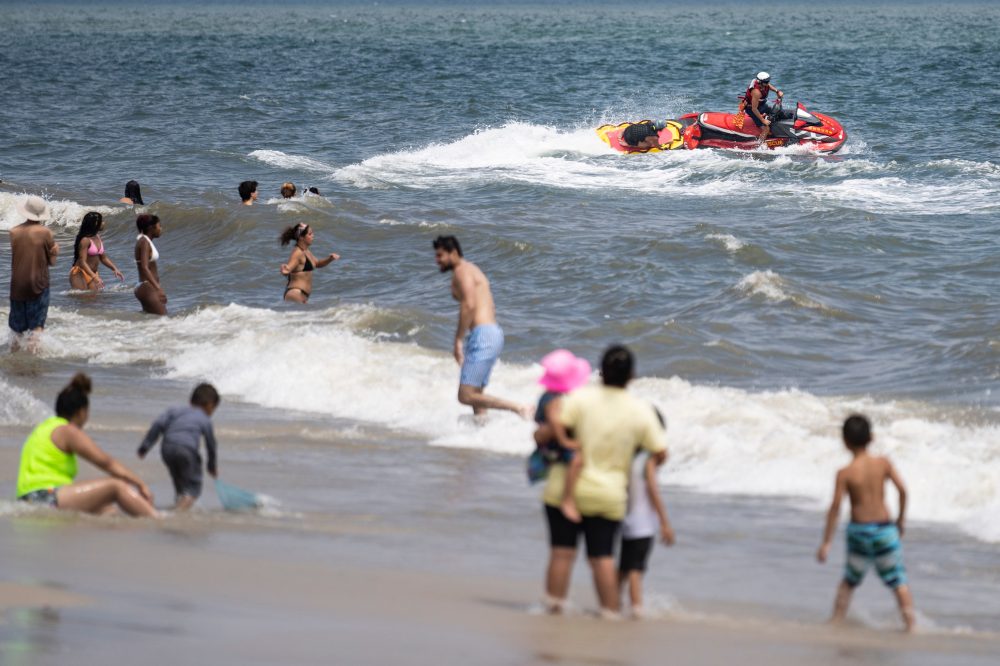

A swimmer was bitten on the foot in what authorities believe was a shark attack Friday at a New York City beach, leading officials to temporarily shut down swimming at the location.
The incident took place at Jones Beach State Park Field 6, where the victim sustained lacerations to their foot. Lifeguards responded right away, and the injured swimmer was transported by ambulance to a nearby hospital. Officials say the injuries were not life-threatening.
The attack at Jones Beach came just one day after multiple shark sightings were reported at other beaches in New York City and on Long Island.
After the bite was reported, swimming was halted so that officials could conduct a search of the water for sharks and other potentially dangerous marine life. After approximately one hour of searching with no sharks found, swimming was permitted to resume — though it was limited to wading no deeper than waist height, according to the New York City Parks Department.
On Thursday, New York City officials reported several shark sightings at Rockaway Beach in Queens, which triggered a series of temporary beach closures. The city’s Emergency Management office issued a public warning about the closures and encouraged beachgoers to follow instructions from lifeguards.
Further east, lifeguards at a Long Island beach spotted a shark Thursday in the waters off Point Lookout and immediately cleared people from the ocean. Both Point Lookout and the neighboring Hempstead beaches were also temporarily closed to swimmers following that sighting.
The surge of beach activity — and the heightened attention to shark sightings — comes as record-breaking heat continues to blanket the eastern United States, pushing large numbers of people toward coastal waters.
Authorities have increasingly turned to drones to scan the water for sharks, which experts say has made sightings more frequent. However, while sharks are a common presence in waters off the U.S. coastline, actual bites remain quite rare.
Gavin Naylor, who leads the shark research program at the Florida Museum of Natural History, told The Associated Press that globally there are between 60 and 80 confirmed unprovoked shark bites each year. He noted that it is extremely unusual for two or more people to be bitten in close proximity to one another.