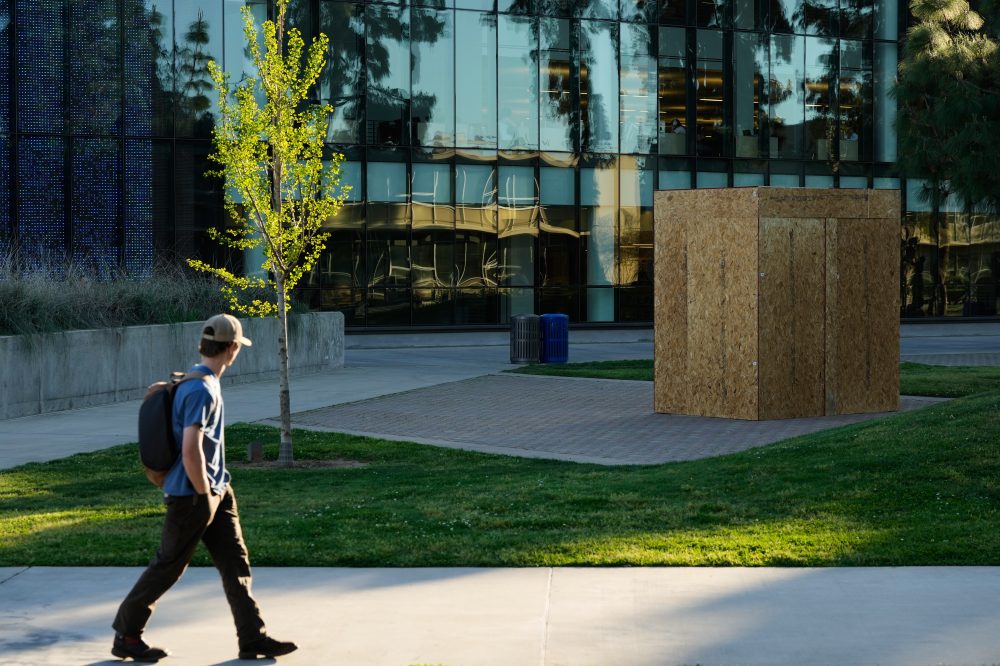

Following shocking sexual abuse accusations against legendary labor organizer César Chávez, officials at California State University, Fresno moved quickly to conceal his campus statue — first draping it with black fabric, then covering it entirely with plywood. University leaders say the monument will soon be removed completely.
This statue represents just one piece of Chávez’s extensive national legacy, with The Associated Press documenting over 130 locations across at least 19 states that bear his name, including educational institutions, roadways, libraries, community facilities, and public spaces.
The once-honored name has now become controversial. Institutions and municipal governments nationwide are beginning efforts to eliminate Chávez’s name from their properties. Beyond physical monuments and street markers, some want to change César Chávez Day, the federal holiday observed on his March 31 birth date.
The accusations that Chávez sexually victimized girls and women, including movement co-leader Dolores Huerta, “call for our full attention and moral reckoning by removing his statute from our campus,” stated Saúl Jiménez-Sandoval, president of California State University, Fresno. The timeline for removal remains uncertain.
Questions also surround the future of the César E. Chávez National Monument in Keene, California, which contains the workspace where some alleged abuse reportedly occurred.
Phoenix city council members announced plans to vote next week on renaming the holiday along with any municipal buildings and streets currently honoring Chávez.
The New York Times initially reported Wednesday that credible evidence exists showing Chávez targeted and sexually victimized young girls within the labor movement. One survivor was motivated to speak out after learning of a proposal to name a street in her neighborhood after Chávez.
Huerta, a labor icon who partnered with Chávez in 1962 to establish the National Farm Workers Association — later renamed the United Farm Workers of America — disclosed to the publication that she experienced abuse from him during her thirties.
Advocates are suggesting that locations currently named for Chávez should instead honor Huerta.
His namesake locations include a U.S. Navy cargo vessel recognizing his World War II military service and a national monument created in 2012 by former President Barack Obama on a 187-acre property where Chávez lived and conducted his work.
While California contains the majority of these locations, sites exist across at least 19 states, spanning from New York and Maryland to Oklahoma, Great Lakes states, and Washington.
Educational institutions account for more than half of these locations, with California hosting most of them. In Pueblo, Colorado, one school honors both Chávez and Huerta in its name.
Modifying a national monument’s designation requires either congressional legislation or presidential action.