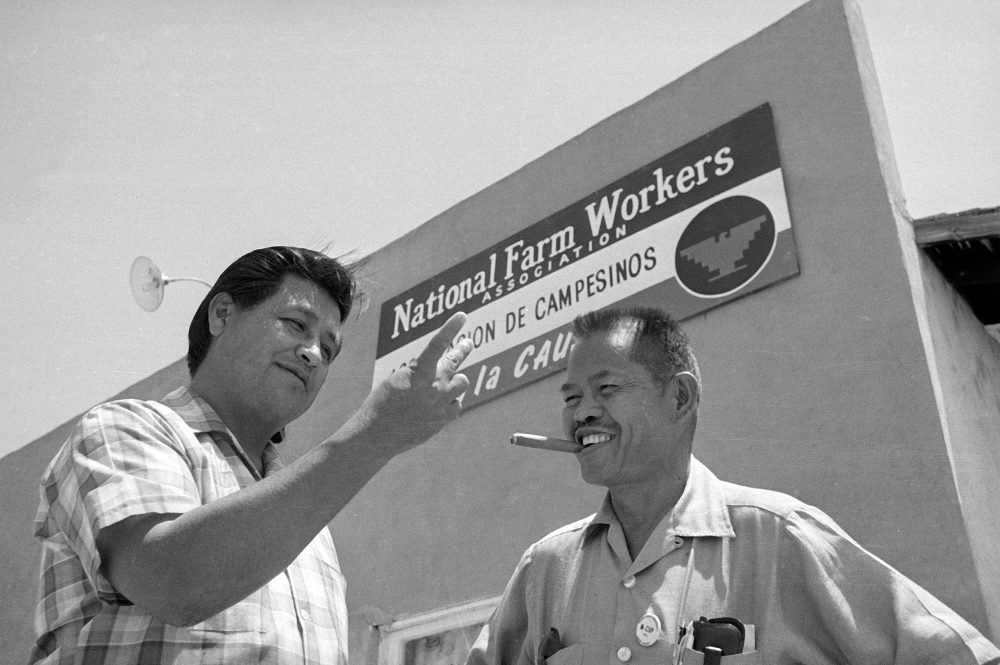

Back in 1965, Filipino and Mexican American farm laborers joined together in a groundbreaking strike against grape growers in California. The historic action brought together Filipino organizer Larry Itliong and César Chavez, who helped establish the National Farm Workers Association. This defining moment has been commemorated through literature, public memorials, and theatrical productions.
Now, following recent sexual abuse accusations against Chavez involving young women and girls within the labor movement, Filipino American communities — including families of the original strikers — are reconsidering how to honor this important historical period.
Several Filipino organizations have called off their planned César Chavez Day marches, while community leaders are pushing to rebrand the March 31 holiday to spotlight Filipino and Chicano farm laborers, especially women, while recognizing those who suffered Chavez’s alleged abuse.
“We really need to kind of center this trauma of women and sexual abuse,” said Dillon Delvo, executive director of Little Manila Rising, a longtime Filipino community hub in Stockton, California. “It’s definitely what the discussion needs to be.”
During America’s colonial control of the Philippines between 1898 and 1946, countless Filipinos learned English and gained permission to move to the United States. Between the 1920s and 1960s, thousands of Filipino immigrants became part of America’s farm labor force, taking jobs on agricultural operations, in processing plants, and canneries, mostly throughout western states. This initial group of men — who came from the Philippines’ Ilocano-speaking areas — earned the nickname “manong,” a loving term meaning older brother.
These Filipino farm laborers faced significant hardships including substandard pay, inadequate living quarters, and dangerous work environments, all while trying to earn money for their families back home. They also dealt with isolation because few Filipino women made the journey to America, and laws banning interracial marriage prevented them from marrying outside their ethnic group.
During the 1960s, Filipino agricultural workers established the Agricultural Workers Organizing Committee to coordinate labor actions.
“It came out of necessity and desperation to protect themselves, to try to live in dignity,” said Dennis Arguelles, Southern California director for the National Parks Conservation Association. The region Arguelles, who is Filipino, monitors includes monuments to Filipino farmworkers and Chavez.
On September 8, 1965, Itliong and co-organizer Philip Vera Cruz guided the Committee’s decision to walk off the job at grape farms in Delano, California. Their demand was simple: payment of at least the federal minimum wage. Itliong, described as the more “fiery union leader,” reached out to Chavez, who along with Dolores Huerta led what was then called the National Farm Workers Association.
“Chavez was hesitant to strike,” Arguelles said. “You didn’t feel like the National Farm Workers Association was ready to take on these powerful agribusiness interests. These business structures were very effective in pitting different ethnicities against each other to break strikes.”
Seven days later, the groups officially merged to form the United Farm Workers. The Delano grape boycott continued for five years and transformed the agricultural industry, ultimately resulting in collective bargaining contracts for thousands of workers.
The widely accepted story of Itliong’s role has typically been linked to Chavez, with both men featured side by side in educational materials, museum displays, and artwork throughout California.
The accusations against Chavez have generated concerns about placing historical figures on pedestals.
“There always seems to be a need to be like a main character,” Delvo said. “But the problem is that is not what a union is about.”
The controversy has also reignited discussions about how Chavez’s prominence may have overshadowed other movement leaders.
“Maybe this is our opportunity to tell a more accurate and comprehensive narrative of what took place,” Arguelles said. “I see that as being a positive thing.”
During a public session last week, the Los Angeles Board of Supervisors began procedures to change César Chavez Day to Farmworkers Day. Some participants proposed shifting the holiday, which falls on Tuesday, to September 8 to commemorate the Filipino workers’ strike. Johnny Itliong, the 60-year-old son of Larry Itliong, claimed Chavez had attempted to “erase the history” of how the Delano strike started.
“I’ve spent my whole life speaking up for my father and his generation of men and women who fed America,” Itliong said at the meeting.
A stage production called “Larry the Musical: An American Journey,” which tells the story of the Filipino farmworkers movement, mentions Chavez just once, during a scene where Itliong contacts him by phone. The show’s creators also ensured the narrative highlighted the women in Itliong’s circle. Current developments have reinforced the wisdom of that artistic choice.
“From the beginning, we have always centered this musical on the women of the community as those who keep Larry and the community accountable, and the ones who pass on knowledge to the next generation,” co-producers Gayle Romasanta and Bryan Pangilinan said in a statement.
Vernadette Gonzalez, an ethnic studies professor at University of California, Berkeley, believes teachers should use this moment to spotlight overlooked figures from the Filipino farmworkers movement. She points out that Latina women in the United Farm Workers were simultaneously caring for their children and providing meals for organizational gatherings.
“Nobody’s crediting them in the minutes of the meeting,” Gonzalez said. “Who’s missing from the story? In the United Farmworkers movement, folks will say ‘It’s Larry Itliong and the Filipino farmworkers.’ But I would also say ‘Where are the women?’”