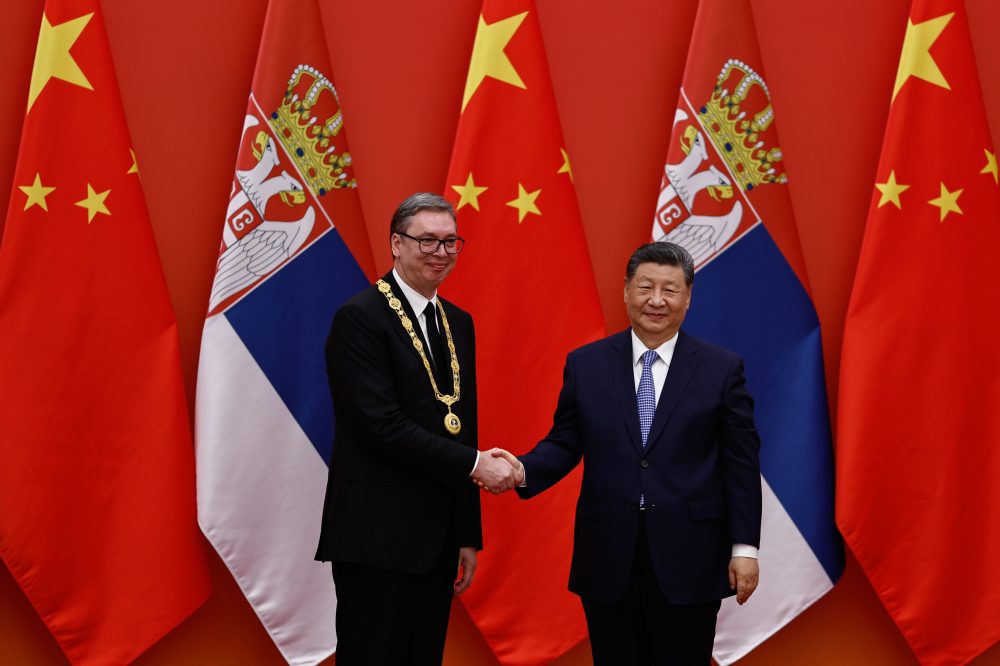

BEIJING (AP) — While tens of thousands of protesters clashed with police in his home country over the weekend, Serbian President Aleksandar Vucic was in Beijing on Monday strengthening his nation’s relationship with China through high-level diplomatic meetings.
Vucic met with Chinese President Xi Jinping, and the two leaders oversaw the execution of more than 20 cooperation deals spanning politics, trade, technology and education sectors, according to Chinese state broadcaster CCTV. During their discussions, Xi emphasized that both nations should enhance their exchanges and collaborative efforts to elevate their comprehensive strategic partnership.
“China supports Serbia in persisting on a development path that suits its own national conditions, and is willing to strengthen exchanges of governance experience with Serbia,” CCTV quoted Xi as saying.
Xi also highlighted the importance of expanding collaboration in artificial intelligence, digital economy and green energy sectors to create new opportunities for growth.
A joint statement issued by Chinese official news agency Xinhua outlined both countries’ position that human rights issues should not be used for political purposes, while emphasizing their commitment to sovereign equality, multilateralism and adherence to international legal frameworks.
According to CCTV, Vucic expressed Serbia’s strong commitment to building relations with China and pledged unwavering support for China’s core interests. Xi presented him with a “friendship medal,” Xinhua reported.
The Serbian leader launched his five-day state visit to China on Sunday while confronting significant political challenges at home. Violence broke out between protest groups and riot police following Saturday’s massive anti-government demonstration that drew tens of thousands of opposition supporters to the Serbian capital of Belgrade.
Vucic has attempted to suppress the widespread demonstrations that have challenged his authoritarian governance in the Balkan nation. However, Saturday’s large turnout indicated that public opposition remains strong more than a year after protests initially began demanding accountability for a fatal train station collapse in November 2024.
The disaster has become a catalyst for widespread frustration with Serbia’s leadership and has sparked increasing public calls for transparency in the corruption-riddled country, which has implemented a rapid succession of major infrastructure developments, primarily through Chinese contractors.
While Serbia officially pursues European Union membership, the country has cultivated relationships with Russia and China. In an opinion piece Vucic published in the South China Morning Post newspaper on Sunday, he argued that European discussions about China are “too often clouded by suspicion and strategic anxiety.”
“I understand that every major political community must guard its future, but I believe Europe should approach China not with fear and suspicion but with confidence and a serious, open-eyed willingness to cooperate,” he wrote.