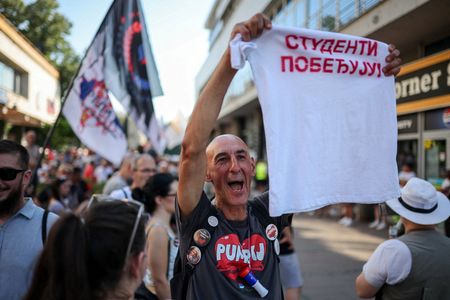

Thousands of protesters were expected to flood the Serbian city of Kraljevo on Sunday, just one day after President Aleksandar Vucic announced his intention to resign and open the door to early presidential and parliamentary elections.
Vucic has held the reins of power in Serbia — first as prime minister, then as president — for 12 years. His tenure has been rocked by months of student-led demonstrations that were ignited by the deadly collapse of a concrete canopy at a railway station in the northern city of Novi Sad in late 2024, which claimed the lives of 16 people.
That tragedy has come to represent widespread frustration over what many citizens view as government corruption and mismanagement under Vucic’s leadership. The resulting wave of protests has grown into the largest Serbia has seen since the fall of Slobodan Milosevic in 2000. Vucic has consistently denied any wrongdoing or corruption.
“This is not just a political struggle but a fight between good and evil,” said Jelena Danicic, a Serbian language professor who met up with friends in the city center ahead of the rally.
Despite sweltering heat, crowds made their way into Kraljevo, where street vendors hawked T-shirts bearing the slogan “Students are winning.”
What started as a demand for accountability over the deaths in Novi Sad gradually evolved into broader calls for Vucic to leave office and hold early elections.
While many in the protest movement feel that Vucic’s announcement vindicates their efforts, they are not convinced he will truly exit the political stage. Political analysts suggest he may seek to run for prime minister and place a trusted ally in the presidency, allowing him to maintain his influence behind the scenes.
“I cannot imagine that he will step down and leave power to someone else,” said Marko Djokic, a 41-year-old IT professional who traveled back to his hometown specifically to take part in the demonstrations.
The situation in Serbia is drawing close attention from both the European Union and Russia. Serbia is a candidate for EU membership and sits just outside the bloc’s eastern border, but it also maintains deep ties with Russia and China — a delicate balancing act Vucic has long navigated.
Before Serbia can join the EU, it must strengthen the rule of law, create conditions for free and fair elections, crack down on corruption and organized crime, bring its foreign policy in line with EU positions, and normalize relations with Kosovo, which declared independence from Serbia in 2008.
Both Brussels and Moscow are watching closely to see how the situation unfolds in the weeks ahead. The EU has spoken out against the use of force on peaceful protesters and has also expressed concern about press freedom and judicial independence in the country.