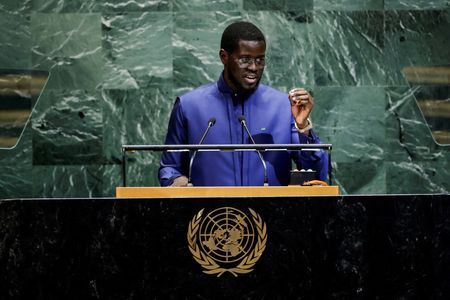

The president of Senegal has given his approval to controversial legislation that increases maximum prison sentences for same-sex relations from five to 10 years while also making it illegal to promote homosexuality, according to an official government announcement.
Parliament members voted by a wide margin to pass the legislation earlier in March, though President Bassirou Diomaye Faye faced significant opposition from international human rights organizations urging him not to enact the measure.
Volker Turk, the United Nations human rights chief, criticized the proposed law on March 12, stating it “flies in the face of the sacrosanct human rights we all enjoy: the rights to respect, dignity, privacy, equality and freedoms of expression, association and peaceful assembly.”
Both Faye and Prime Minister Ousmane Sonko had pledged during their 2024 election campaigns to implement stricter anti-LGBT legislation. The two leaders signed the bill into law on Friday, as confirmed by a government announcement dated Monday and shared by a government spokesperson on Tuesday.
Previously, Senegal’s criminal code included provisions that imposed prison sentences of up to five years and financial penalties reaching 1,500,000 CFA francs (equivalent to $2,700) for what it termed “acts against nature.”
The updated legislation increases the maximum sentence to twice the previous length and raises potential fines to as much as 10 million CFA francs.
The new law explicitly defines acts against nature as including homosexuality, bisexuality, “transsexuality,” zoophilia and necrophilia.
Individuals convicted of promoting or providing financial support for such activities will also face imprisonment.
Reuters previously reported that Senegalese supporters of the legislation had coordinated with a United States-based “pro-family” organization that characterizes homosexuality as a threat to public health, discussing campaign tactics and mobilization strategies.
In the weeks before lawmakers cast their votes on the bill, there was a notable increase in arrests of men suspected of “acts against nature” and, in certain instances, “voluntary transmission” of HIV, which carries a potential 10-year prison sentence.