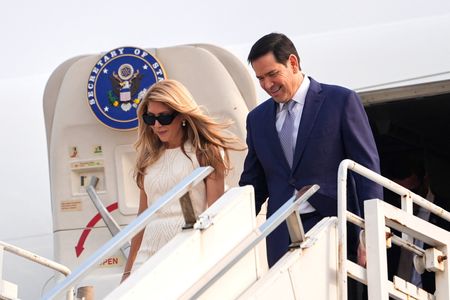

U.S. Secretary of State Marco Rubio touched down in India Saturday, beginning a crucial four-day diplomatic visit designed to rebuild a relationship strained by trade conflicts and President Donald Trump’s tariff policies.
This marks Rubio’s inaugural journey to India, with scheduled visits to Kolkata, Agra, Jaipur and New Delhi. According to the State Department, discussions will center on trade partnerships, energy collaboration and defense cooperation.
American leaders, including Trump during his initial presidency, have consistently worked to draw the historically neutral nation closer as a balance against Russian influence and China’s expanding presence in the Indo-Pacific region. However, these diplomatic efforts suffered a significant setback when Trump imposed some of America’s steepest tariffs on Indian goods last year.
While many of these trade penalties were reduced through a temporary agreement, both nations have yet to reach a final comprehensive trade deal.
Indian officials had pushed for a Trump visit connected to a Quad summit involving the United States, India, Japan and Australia, but experts indicate this proposal was shelved due to trade disagreements and other pressing matters, including the U.S.-Israeli conflict with Iran.
Meanwhile, America has strengthened relationships with India’s neighboring rival Pakistan, with Islamabad playing a crucial role in peace negotiations, creating additional friction in U.S.-India relations.
The energy emergency triggered by the U.S.-Israeli conflict with Iran has also hindered American attempts to reduce India’s dependence on Russian oil.
Speaking Thursday, Rubio identified energy as a primary focus, noting ongoing discussions to increase America’s portion of India’s energy imports.
“We want to sell them as much energy as they’ll buy,” he said. “There’s a lot to work on with India. They’re a great ally, a great partner. We do a lot of good work with them.”
For Indian officials, Trump’s recent visit to Beijing this month heightened worries about American commitments, according to Basant Sanghera, a former State Department South Asia policy expert now with The Asia Group consultancy.
Sanghera explained that Trump’s strategy had “created a perfect storm of anxiety” in India regarding the U.S. relationship, “but ties have stabilized and both sides are trying to build momentum in the areas that there is convergence.”
The previous Biden administration prioritized India as a crucial strategic ally and honored Prime Minister Narendra Modi with a 2023 state visit. Trump also hosted Modi at the White House early in his second term before implementing harsh tariffs that derailed diplomatic progress.
U.S. Ambassador Sergio Gor, nicknamed “the India whisperer” by Michael Kugelman of the Atlantic Council think tank, began his duties in New Delhi in January and has worked to restore relations. Gor maintains a personal friendship with Trump and previously served as a White House adviser.
In February, both countries established a “framework for an interim agreement” on trade, reducing Trump’s tariffs on Indian products to 18% from a severe 50%, with half previously tied to India’s earlier Russian oil purchases.
However, negotiations to complete the agreement stalled after the U.S. Supreme Court overturned Trump’s tariffs in late February.
This decision effectively lowered duties on Indian goods to 10%, but New Delhi continues evaluating its options as the Trump administration pursues investigations under unfair trade practices laws expected to reinstate much of the previous levies.
A source familiar with the negotiations revealed American disappointment with India’s perceived delays and apparent expectation of securing favorable terms without significant concessions, a sentiment likely to complicate Rubio’s efforts to stabilize relations.
“I do not expect Secretary Rubio will have much impact in changing the downward trajectory,” said Richard Rossow of the Center for Strategic and International Studies think tank.
“The lack of a trade agreement – more than three months after the announcement of the ‘interim deal’ – clouds other areas of engagement.”
India’s requests for the White House to arrange a Trump visit for a Quad summit, designed to counter China’s growing influence, remain unanswered, according to another source familiar with the discussions.
Rubio’s upcoming meeting with fellow Quad foreign ministers in Delhi will mark the third such gathering without leader-level participation and represents an “unannounced downgrade” of the alliance, Rossow noted.
Despite this, the U.S. Embassy in New Delhi posted on X emphasizing the Quad’s significance, stating it stands “together for a free and open Indo-Pacific… From supporting regional security to diversifying critical minerals supply chains.”