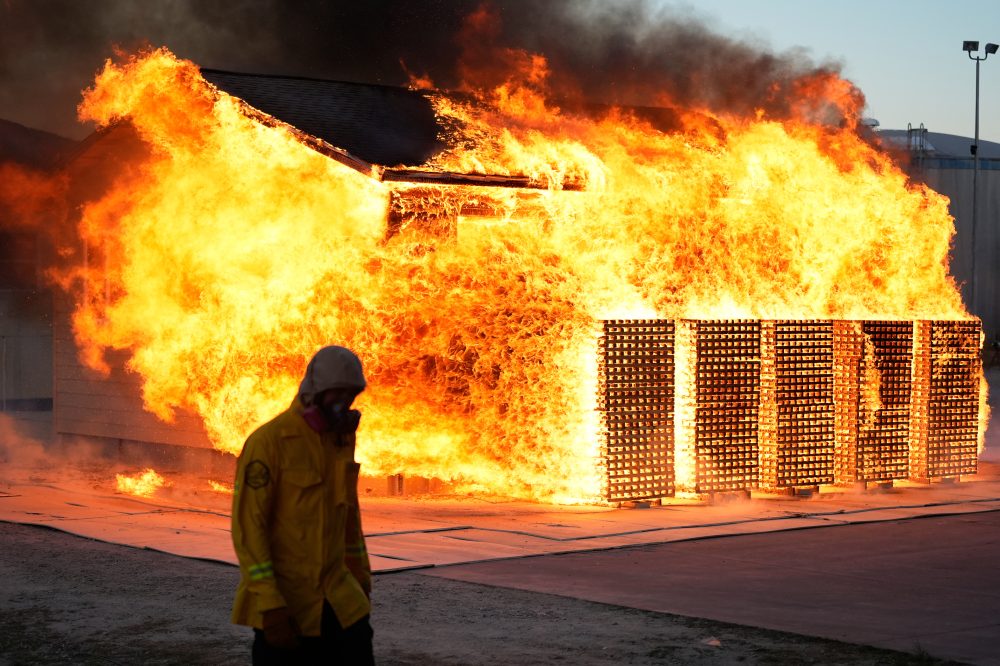

RICHBURG, S.C. — In under three minutes, powerful winds pushed flames along the exterior of a test home until they shattered windows and crept beneath the roof line, consuming everything within. Several weeks later, researchers constructed an identical structure in the same location and set it ablaze once more — all for scientific research.
The second dwelling burned at a much slower rate due to enhanced fire-resistant construction materials. Scientists discovered that relocating flammable items like vegetation, mulch, wooden barriers and hot tubs with combustible insulation at least several feet from structures can significantly defend homes against escalating wildfire threats in our changing climate.
This groundbreaking research takes place at an isolated facility in South Carolina, where teams have intentionally ignited 13 residential structures as part of their mission to understand fire behavior through controlled burning experiments.
The specially designed test homes contain multiple sensors and cameras that the facility director described as equipment that will “give their life for science.” Surrounding the burn area sits nearly $1 million worth of additional recording equipment and monitoring devices housed in a fireproof structure and positioned throughout the testing grounds.
The Insurance Institute for Business & Home Safety operates as a nonprofit organization established by insurance companies to enhance building resilience against natural disasters. Their 100-acre research campus in Richburg, South Carolina originally focused on studying hurricane impacts and severe weather patterns involving high winds and heavy rainfall.
With wildfire risks growing in recent years, researchers now redirect their massive six-story wall containing 105 stacked fans to blow air out through the wind tunnel’s enormous openings, helping spread controlled fires during experiments.
“We crash test houses,” explained Roy Wright, who serves as the institute’s president.
Between 2016 and 2025, annual wildfire destruction across the United States averaged an area equivalent to Massachusetts — approximately 11,000 square miles (28,500 square kilometers). This represents 2.6 times the typical burn area recorded during the 1980s, based on National Interagency Fire Center data. Canadian wildfire statistics show their average burned acreage over the past decade reached 2.8 times the 1980s levels, according to the Canadian Interagency Forest Fire Centre.
Since 2020, wildfires have generated an average of $17.7 billion annually in damages throughout the United States, according to records maintained by the National Oceanic and Atmospheric Administration and Climate Central, a nonprofit research organization.
Climate change continues to intensify fire seasons and expand their duration across America, while population growth places dense residential developments in fire-prone regions. Over the last three years, catastrophic wildfires devastated California, Hawaii’s Maui island, and mountainous areas of North and South Carolina.
Drought conditions throughout much of the nation — particularly affecting western and southeastern regions — have reached record severity levels for this time period. Combined with unprecedented heat and extremely low moisture readings in western states during the first quarter of 2026, the upcoming fire season appears likely to be exceptionally dangerous unless significant late spring or early summer precipitation provides relief, according to UCLA climate and fire researcher Park Williams.
Research findings from the institute have already strengthened California’s fire safety regulations. New residential construction must now include ignition-resistant wall systems, tempered or double-pane windows, and protective mesh covering vents to block fire embers from entering structures.
Exterior property management proves equally crucial. Establishing a 5-foot (1.5-meter) clearance zone free from easily ignitable materials such as pine needles, hot tubs, wooden fencing, or overhanging tree branches creates an essential defensive barrier.
The controlled burn experiments clearly demonstrate this principle. Research teams ignite wooden blocks resembling Jenga game pieces within the buffer area. Simulated winds, deliberately varied between 30 and 55 mph (50 to 90 kph) during recent testing, continuously drove flames toward the target structure.
After fire breaches windows and walls, interior combustible items including furniture, upholstery, clothing and plastic materials rapidly ignite, producing massive showers of dangerous burning debris carried by strong winds that can spark new fires one or two blocks away.
However, fire safety standards have limitations. “Under really severe fire conditions, especially those involving very high winds, they probably are of more limited value,” noted Syracuse University fire researcher Jacob Bendix.
Fire prevention products and methods have become a growing industry sector.
Following the 2018 Woolsey fire near his Ventura County, California residence, Nicholai Allen observed firefighters applying fire retardant chemicals and wondered whether homeowners could use similar approaches. He trained as a wildland firefighter and learned that preventing embers from entering attics and garages represents the critical factor.
Allen now manufactures and markets Safe Soss (pronounced like sauce), a product line featuring carbon filters and guards for attics and vents, fiberglass heat-resistant ember-blocking tape, and spray fire retardant compatible with garden hoses — all recently made available through a major hardware retailer.
Allen draws comparisons to winter preparation routines in northern climates.
“It’s kind of like if you live in the snow, you have a snow shovel, you have scrapers, and you know that you have to take certain preventative steps in order to live in an environment that, hey, sometimes snows,” Allen explained.
The Insurance Institute for Business & Home Safety conducts their fire experiments under strict safety protocols. Test structures are built to closely replicate typical residential construction while omitting electrical systems and plumbing.
Safety procedures and attention to detail follow rigorous standards. The institute prefers conducting spring fire tests at their location between Charlotte, North Carolina and Columbia, South Carolina because while summer temperatures in the South can approach those found in fire-prone western regions, the humid conditions in July poorly represent dry mountain canyon environments.
Strong winds delayed a recent test for over six hours, with concerned staff worried they couldn’t postpone until the following day due to an outdoor burning prohibition taking effect after an unusually dry and hot spring season.
Protective covers and heating equipment bring houses to summer temperature levels immediately before fires are ignited on a large concrete platform outside the massive hangar housing the fan wall and hurricane testing operations.
At other areas of the facility, researchers have begun investigating hail damage to residential structures. Another section contains dozens of roof sections positioned at ground level where shingles endure freezing, heating, and natural weather exposure for over a decade as part of additional testing programs.