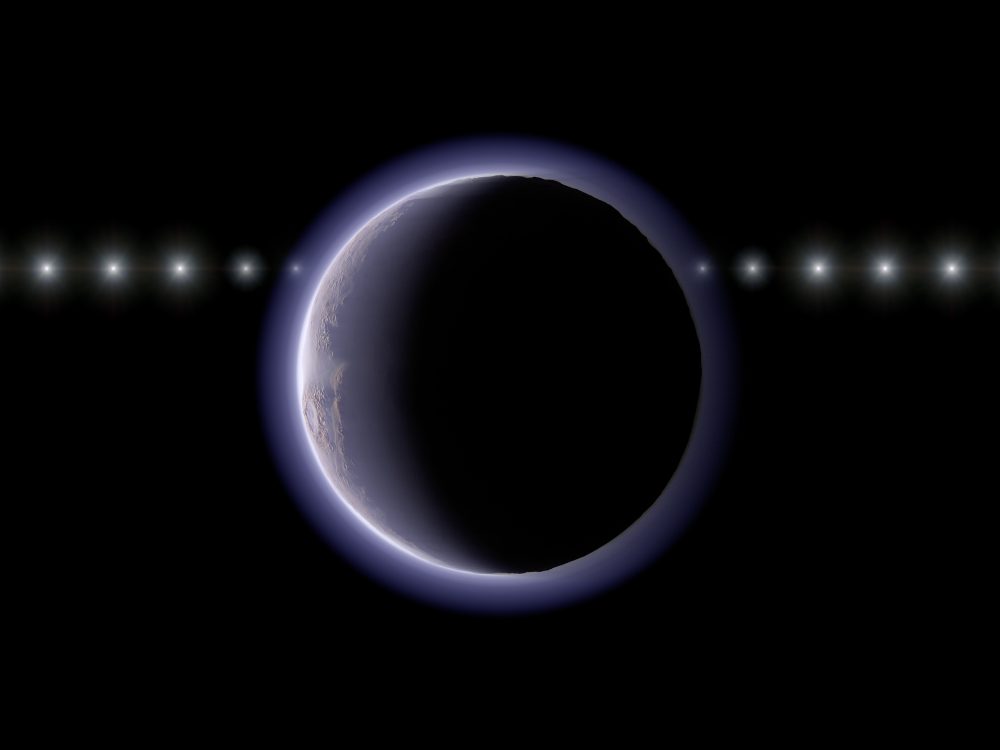

CAPE CANAVERAL, Fla. (AP) — Scientists report discovering what appears to be a fragile atmosphere surrounding a small, frozen celestial body located in the outer reaches of our solar system past Pluto, possibly formed through volcanic activity or an impact from a comet.
Measuring approximately 300 miles (500 kilometers) in diameter, this distant mini-world may represent the smallest celestial object in our solar system confirmed to possess a gravity-bound global atmosphere, according to lead study author Ko Arimatsu from Japan’s National Astronomical Observatory.
“This is an amazing development, but it sorely needs independent verification. The implications are profound if verified,” stated Alan Stern from the Southwest Research Institute, who headed NASA’s New Horizons mission to Pluto and wasn’t part of this research.
The discovery provides new understanding about the most distant, frigid objects inhabiting the Kuiper Belt region of our solar system. Scientists employed three Japanese telescopes to study the object during 2024 when it crossed between Earth and a distant star, causing temporary dimming of the starlight.
“It changes our view of small worlds in the solar system, not only beyond Neptune,” Arimatsu explained via email. He described discovering an atmosphere around such a diminutive object as “genuinely surprising” and noted it contradicts “the conventional view that atmospheres are limited to large planets, dwarf planets and some large moons.”
The minor planet, officially designated (612533) 2002 XV93, belongs to a class called plutinos, completing two solar orbits during Neptune’s three-orbit cycle. When observed, it sat more than 3.4 billion miles (5.5 billion kilometers) from Earth, positioned even farther than Pluto, which remains the only other Kuiper Belt object known to possess an atmosphere.
This frozen world’s atmosphere appears to be between 5 million and 10 million times less dense than Earth’s protective atmospheric layer, based on research published Monday in Nature Astronomy journal.
The atmosphere measures 50 to 100 times thinner than Pluto’s already sparse atmospheric envelope. Arimatsu suggests the most probable atmospheric components include methane, nitrogen or carbon monoxide, any of which could explain the observed starlight dimming during the object’s transit.
Additional observations, particularly using NASA’s Webb Space Telescope, might confirm the atmosphere’s composition, Arimatsu noted.
“That is why future monitoring is so important,” he explained. “If the atmosphere fades over the next several years, that would support an impact origin. If it persists, or varies seasonally, that would point more toward ongoing internal gas supply” from ice volcanoes.