
NEW DELHI (AP) — What started as a satirical internet project has transformed into a massive digital movement attracting millions of frustrated young Indians seeking an outlet for their discontent.
The Cockroach Janta Party, a mock political organization using the resilient insect as its emblem, has taken Indian social media by storm through absurdist comedy turned into political protest. Social platforms have been flooded with satirical content and brief videos ridiculing government corruption, unemployment, and political failures, with millions of users adopting the cockroach — celebrated for surviving in tough environments — as a humorous symbol of persistence.
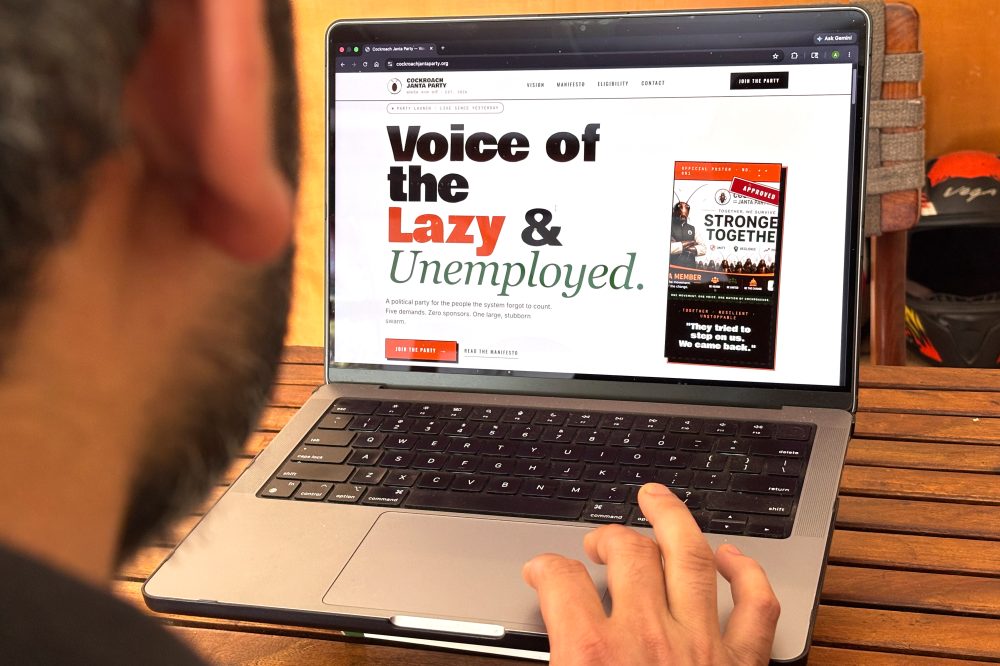
The digital campaign’s growth has been remarkably swift. The Cockroach Janta Party, known as CJP, launched its website and social media presence on Saturday. By Thursday, its Instagram account had gathered over 15 million followers, dramatically exceeding the 8.8 million followers of Prime Minister Narendra Modi’s governing Bharatiya Janata Party on the same platform.
“Nothing of this was intentional,” CJP founder Abhijeet Dipke told The Associated Press, explaining that the movement’s surge demonstrated growing discontent among India’s youth.
“It is the younger people who were actually very frustrated. They didn’t have any outlet. They were really angry at the government,” said Dipke, a political communications strategist and Boston University student.
The CJP appeared online following comments by Supreme Court Chief Justice Surya Kant that sparked outrage among young Indians frustrated by joblessness, increasing living expenses, and recent government exam paper leaks that have disrupted hiring processes.
During a court session last week, Kant condemned what he called “parasites” undermining institutions and likened some jobless young people and activists to cockroaches.
“There are youngsters like cockroaches, who don’t get any employment or have any place in the profession,” Kant said. He noted that some turned to social media activism, journalism or public interest campaigns and “start attacking everyone.”
The statements rapidly circulated online, where numerous users interpreted them as condescending. Kant subsequently explained that his comments targeted people with fraudulent credentials and stated he didn’t mean to offend India’s youth.
However, the backlash soon resulted in the satirical CJP Instagram account, which embraced the cockroach as its political emblem and started sharing humorous content, fake campaign messages, and satirical criticism of Modi’s administration.
In a matter of days, it attracted tens of thousands of online supporters through Google form submissions, along with backing from some opposition politicians.
“We have to understand that five years ago nobody was ready to speak up against Modi or the government. The times are changing,” said Dipke, who previously collaborated with the Aam Aadmi Party, which grew from India’s anti-corruption movement in 2012.
Dipke emphasized that the CPJ operates independently from any actual political organization. However, its emergence reflects a wider pattern across South Asia, where young people have been central to anti-government protests recently, including revolts in Sri Lanka and Bangladesh and disturbances in Nepal.
“The youth are really frustrated and the government is not acknowledging their concerns,” Dipke said.
These challenges are particularly intense in India, where young people comprise more than a quarter of the population, yet many encounter limited employment prospects, ongoing joblessness, and increasing dissatisfaction with established political parties.
Many young voters also express anger toward Modi’s ruling Hindu nationalist party regarding issues such as increasing religious division, expanding inequality, and economic hardships.
The CJP heavily embraces self-deprecating humor.
Its satirical membership requirements include being jobless, lazy, constantly online, and skilled at professional complaining. Its platform uses comedy to tackle various controversial topics in Indian politics, including opposition claims of election fraud, criticism of connections between corporate media and government, and the naming of former judges to government positions.
Some critics, many supporting Modi, have rejected it as an online political stunt connected to the opposition, pointing to Dipke’s previous work with the Aam Aadmi Party. They also suggest the popularity boom will disappear as rapidly as it appeared, claiming it’s a digital campaign rather than a genuine grassroots effort.
But Dipke argued what started online would likely expand beyond social media.
“This is the movement that has arrived in India … it will change the political discourse,” he said. “It will continue online, and if required it will also come on the ground.”
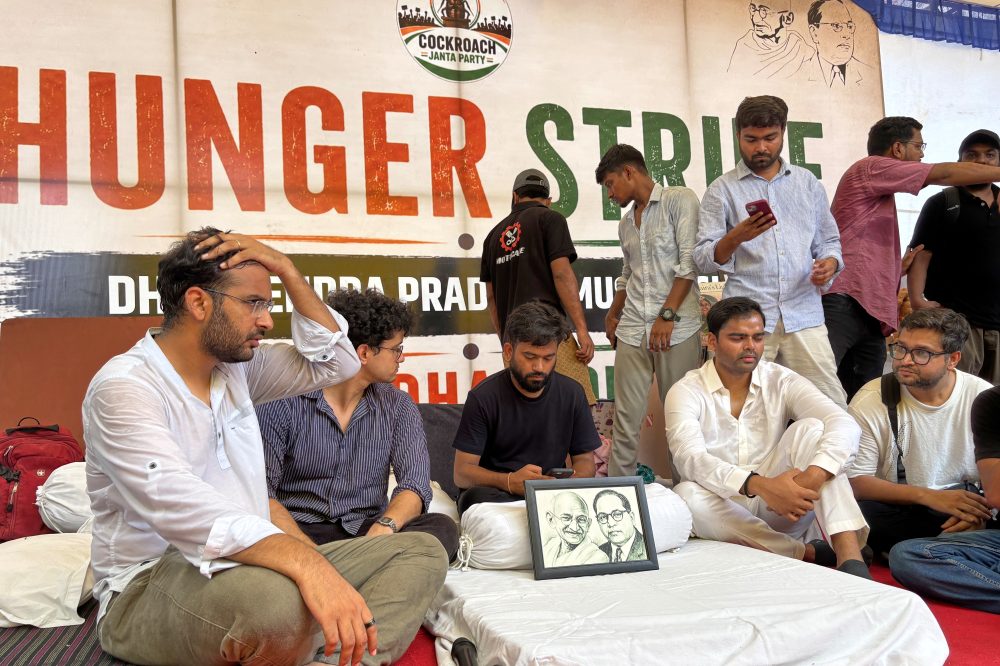
The campaign has already started gradually moving offline, with some young supporters showing up at demonstrations wearing cockroach costumes.
So has the evident resistance.
On Thursday, Dipke posted on X that the CJP’s account on the platform, which had approximately 200,000 followers, had been blocked in India, representing one of the first clear restrictions on the rapidly expanding satirical movement. The explanation wasn’t immediately available.
Shortly after, Dipke revealed a new account for the organization, accompanied by a graphic stating “Cockroach is back.”
The message concluded: “You thought you can get rid of us? Lol.”