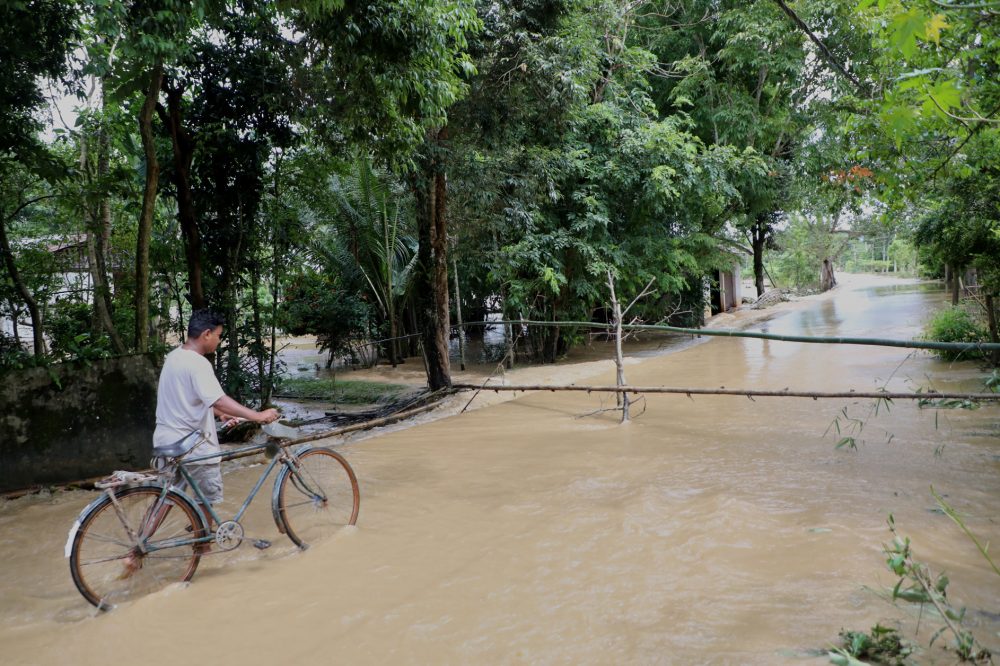

At least 50 people have lost their lives and roughly 700,000 have been driven from their homes following catastrophic flooding in India’s northeastern Assam state, according to officials who spoke on Friday. The disaster was triggered by days of intense monsoon rainfall that caused the Brahmaputra River to overflow its banks.
The Brahmaputra, among the largest rivers in all of Asia, has its origins in China’s Tibet region and travels approximately 900 kilometers — about 560 miles — through Assam before the flooding inundated villages, destroyed homes, and pushed close to 300,000 residents into government-operated relief camps.
Assam’s Chief Minister stated that authorities have been delivering food and essential supplies to those affected, including helicopter airdrops to reach isolated communities. He also noted that nearly 900 villages have been submerged and more than 7,000 households are currently without power.
Emergency responders, including police, disaster response teams, and community volunteers, have been working around the clock to rescue people trapped by the floodwaters and get critical supplies to hard-hit areas.
Jatin Gogoi, a 52-year-old farmer from Nazira, described losing everything when the rising water demolished his bamboo home and wiped out his means of income. “I lost all my cattle. My five-member family and I have nowhere to go, so we are taking shelter in a relative’s home,” he said by phone.
The flooding also disrupted life in Guwahati, the state capital with a population of around 2 million, when waters rose Thursday evening and left roads impassable for hours. “I had to stay overnight at my office. The roads were filled with water, some waist deep,” said Sudip Mazumdar, a journalist based in the city.
Climate scientists warn that human-driven climate change is making South Asia’s monsoon seasons more severe. The monsoons, which historically occur from June through September and again from October to December, have become increasingly unpredictable — now delivering intense bursts of rainfall in short windows followed by prolonged dry periods.