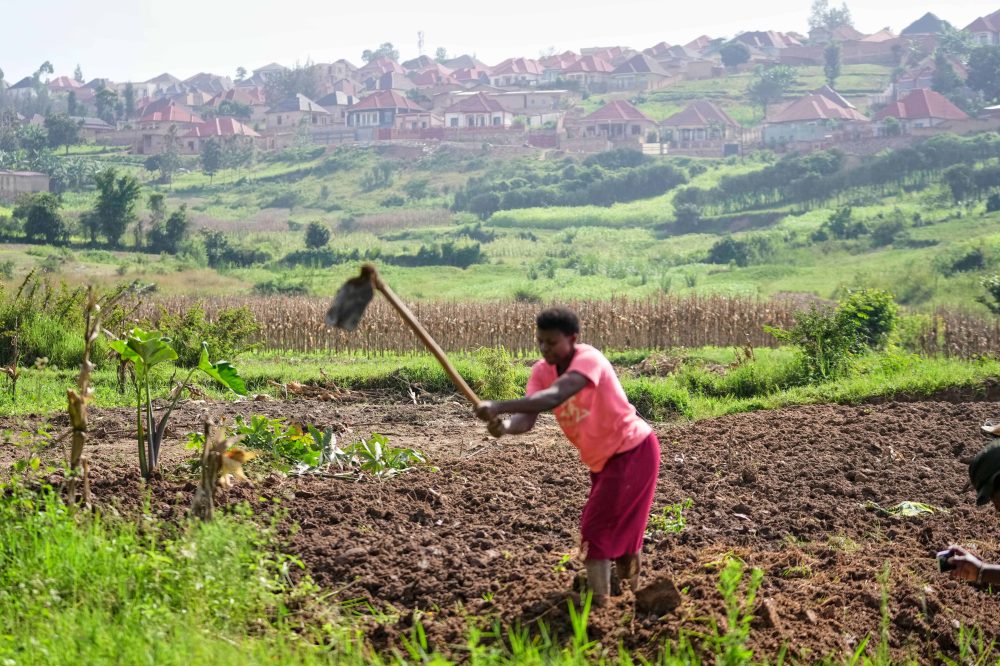

KIGALI, Rwanda — Construction noise drowns out the sound of farming tools on a cold morning in Rwanda’s capital city, as new initiatives work to safeguard what’s left of agricultural areas from constant urban expansion in the continent’s most crowded nation.
Mukarusini Purisikira, 84, worked as a farmer before fleeing to Congo during Rwanda’s 1994 genocide. When she returned home, she discovered that her family’s expansive hillside property had been seized for building projects. She pointed toward the towering structures now dominating Kigali’s skyline.
Today, she cultivates corn and sweet potatoes on a plot no bigger than a small house, which she says provides barely enough food for survival.
“It is all I have,” she stated, nervously watching construction machinery operating on a nearby hilltop.
Her situation now has some protection. Beginning in September, Rwanda’s administration started creating detailed maps of farming areas and employing satellite technology to monitor any development that threatens agricultural zones and wooded areas in a nation whose population is projected to hit 22 million within the next few years.
Rwanda is working to guarantee food security while facing recent global challenges affecting farm supplies like fertilizer, whose costs have increased since the Iran conflict started.
Officials have established penalties reaching $3,000 and prison sentences up to six months for developers caught violating farmland boundaries.
Several structures in Kigali have been demolished, though individuals connected to these properties declined to speak publicly due to concerns about government consequences. Officials now intend to deploy drones for enhanced real-time surveillance.
Data from the mayor’s office reveals that Kigali’s master development plan allocates nearly one-fourth of the area — 22% — specifically for farming purposes.
Municipal leaders recognize that residential construction remains appealing because of high demand but emphasize that future analysis indicates “farming will be even more productive.” They note that food demand is also increasing and believe technological advances can enable cultivation on reduced land areas.
Although most food eaten in Kigali originates from other regions within Rwanda, agricultural space in those locations is also decreasing, according to mayoral office spokesperson Emma-Claudine Ntirenganya, who spoke with The Associated Press.
Last year, the government created and posted maps throughout Rwanda’s districts showing which zones are designated for development and which are protected for agriculture.
Ntirenganya discussed approaching agriculture “in an urban way. We will be able to show Kigalians that they can also do agriculture and be productive.”
The municipal government, which is installing a greenhouse on its building’s roof, mandates that developers applying for construction permits must incorporate green areas and gardens into their project plans.
Additional strategies in Kigali feature vertical farming operations, where crops and fruits like strawberries grow in stackable plastic systems.
Christian Irakoze helped establish a local business called Eza Neza, meaning “grow well,” which creates vertical farming installations throughout the city and calls them expandable. The AP toured two residential locations and another that supplies produce to a grocery retailer. One facility produces 600 plants arranged vertically along approximately 50 meters of perimeter fencing.
Irakoze characterized his work as “a different way of thinking about farming, from traditional large-scale upcountry farming to something smaller, modular, and that anyone can really do.”
By utilizing locally sourced materials like animal waste and volcanic soil as alternatives to traditional dirt, Irakoze explained that farming methods should adapt to reduce external dependencies.
“We really have to find ways to find our own solutions, whether through inputs like fertilizers or seeds. Some of these global events are always a reminder that we should definitely have some alternatives,” he stated.
In other parts of Kigali, a team of young agricultural specialists is teaching farmers to implement technologies like hydroponics to increase output using water rather than soil.
“The population is increasing, yet our land is not increasing. We make sure that we find solutions that can help farmers to overcome that, and then they produce more,” explained agronomist Richard Bucyana.
Bucyana confirmed that innovations like Rwanda’s help protect against international disruptions.
“African governments should start thinking how they can be self-sustainable,” he concluded.