
(Editor’s note: Taylor Ross serves as a Teaching Instructor and Undergraduate Advisor in the Department of Animal Sciences at Rutgers University-New Brunswick.)
The topic of animal well-being has gained significant attention among farmers and the general public in recent years. In the past, we primarily focused on negative indicators of welfare, tracking things like disease, injuries, stress, and decreased productivity.
While these negative factors are clearly undesirable and relatively easy to observe and measure, they don’t tell the complete story. Does an animal that isn’t suffering necessarily enjoy positive welfare and a good quality of life? How can we evaluate animal well-being more comprehensively and identify positive indicators? What happens when an animal displays mixed welfare signals, appearing content while experiencing health problems?
These positive indicators prove more challenging to recognize and measure. It’s crucial to examine multiple factors for this very reason. Context is always important when evaluating welfare, since various factors influence each other and cannot be completely isolated.
Over the years, researchers have developed numerous frameworks to tackle these questions, creating new approaches and improving existing methods as additional research emerges.
Currently, the most comprehensive and effective approach is the Five Domains Model, published by Mellor and colleagues in 2020.
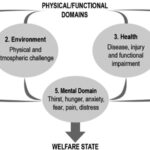
In this model, Mellor and his team demonstrate how four functional areas, which we largely control, ultimately combine to shape the animal’s mental state. The framework shows how different aspects of an animal’s life overlap and interact, ultimately influencing how they view their existence and handle stress, whether real or perceived.
The nutrition category is typically one that animal caretakers study and grasp well. This area encompasses providing both water and food, and crucially, appropriate food for each species. When problems arise, they usually occur here through inadequate micronutrients or suboptimal feeding schedules and methods.
Feeding animals as closely as possible to what their wild ancestors consumed generally works best, such as pasture for most livestock and horses. However, effective strategies exist to balance captivity with proper nutrition for all species. Some approaches will connect with other areas, including behavioral interactions or health considerations.
The environmental category concentrates on the animal’s living quarters, whether that’s an expansive pasture, a medium-sized barn, or a small stall. It also encompasses the conditions and other elements within that space: temperature, humidity, air quality, equipment and structures, other animals, and more.
Health represents another area that has consistently received attention from owners, particularly with veterinary assistance and biosecurity protocols.
Maintaining animals free from disease and injury, or at least minimizing these issues, while ensuring they produce their intended output (meat, milk, offspring, athletic performance, etc.) defines this domain. This area also clearly demonstrates how the domains interconnect. When nutrition falls short somehow, health quickly begins to decline. When animals experience prolonged heat or cold stress, weight and production losses follow. Repetitive behaviors can physically harm the animal. Historically, this domain has been our primary indicator of welfare problems.
These initial three domains concentrate on factors that reveal internal imbalances and have maintained solid research foundations for years, representing some of the first considerations producers address for their animals. The behavioral domain has experienced significant changes and improvements recently.
This area focuses on external interactions and behaviors in our animals. It can be divided into three main interactions: with the environment, other animals, and humans. Observing how animals choose to interact, or avoid interaction, with these three areas and their manner of doing so can indicate positive or negative welfare outcomes. Do they move toward or away from humans entering their space? Do they engage with enrichment items we provide? Do they groom their herd companions?
These four functional domains combine to influence the mental domain, which ultimately determines what the animal is “experiencing.” This domain essentially represents the positive or negative effects of the elements we control in the other four areas.
For instance, consuming a balanced diet in appropriate amounts produces signs of satisfaction and comfort. Failing to provide sufficient mental stimulation results in boredom behaviors. Implementing low-stress handling techniques significantly reduces stress indicators and increases tolerance of humans, potentially leading to animals actually liking humans and seeking them out.
This domain is the most individual-specific since it reveals how each animal perceives their experience. Even when we provide identical “correct conditions” for cattle, different herds may show varying levels of contentment, with even greater differences among individual herd members.
One farmer might need to provide additional enrichment, modify their handling techniques, or adjust nutrition more than another to achieve similar results. This explains why we always evaluate welfare within complete context and examine the entire herd when individual customization isn’t practical. This approach can also help with culling decisions to relocate animals that don’t adapt as well to different environments.
Evaluating welfare presents challenges because every aspect of an animal’s life impacts it. Using a systematic framework to methodically examine each component helps us identify improvement areas and provides a foundation for advancing toward evaluating positive welfare indicators rather than simply confirming the absence of suffering.