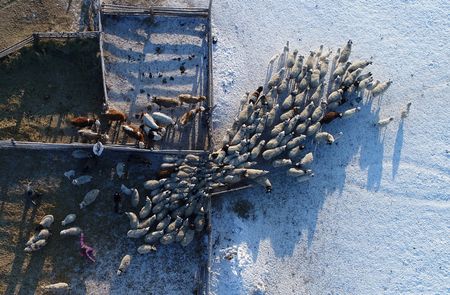

Russian government officials acknowledged Friday that additional unidentified diseases are worsening a livestock crisis in Siberia that has resulted in the mass slaughter of thousands of cattle and triggered unusual public demonstrations against the government’s response.
Sergei Dankvert, who leads the government panel examining the situation, told Komsomolskaya Pravda newspaper that veterinary officials struggled to carry out such unpopular actions. “However, this concerns an outbreak of a dangerous infectious disease, pasteurellosis, complicated by other illnesses, and incurable rabies,” Dankvert explained, though he did not identify what those additional diseases were.
The widespread animal killings have generated uncommon opposition in wartime Russia, with livestock owners demanding that senior agricultural officials step down from their positions.
American agricultural experts are raising questions about Russia’s explanation of the crisis. The U.S. Department of Agriculture’s Foreign Agriculture Service released a Friday report citing local contacts who suggested “the scale of these measures may indicate an unconfirmed outbreak of foot-and-mouth disease.” The agency noted that Moscow’s handling of the situation “raised concerns about the adequacy of current vaccines and the potential impact on Russia’s cattle trade.”
Russian agricultural authorities have not responded to inquiries about whether foot-and-mouth disease might be present. This distinction matters significantly because Russia received certification from the World Organisation for Animal Health in 2025 as being free of foot-and-mouth disease. The extremely transmissible viral infection typically demands large-scale animal culling, and any verified cases could severely damage Russian farm exports, which President Vladimir Putin has directed officials to boost by 50% before 2030.
Documents obtained by the U.S. agency show that Russia implemented a complete ban on livestock shipments from 15 impacted regions across Siberia and central Russia, effective February 25.
The Novosibirsk region in Siberia announced an emergency declaration earlier this week to address the crisis, with local officials attributing the problem to pasteurellosis, described as a serious bacterial lung infection, along with rabies cases.
Animal killings continued Friday in Kozikha village, located 45 miles southwest of Novosibirsk, based on eyewitness reports and video footage from the location.
Svetlana Panina, a prominent demonstrator who lost 150 cattle in the government’s culling program, shared a video message saying authorities briefly held her for questioning as a witness regarding an arson incident at an animal burial location.
According to Dankvert, laboratory analysis revealed that the pasteurellosis strain in the initial outbreak had changed genetically and was displaying more severe symptoms than typically seen. “In such a situation, the only way to stop the spread is the rapid removal and destruction of sick and suspect animals, as is done worldwide,” he stated.