
Ukrainian officials report that Russian military forces have continuously directed missiles and drones along flight paths dangerously close to the abandoned Chornobyl nuclear facility during their ongoing attacks, creating potential for a catastrophic nuclear incident.
Ukraine’s Prosecutor General Ruslan Kravchenko shared these details about previously undisclosed Russian military operations near Ukrainian atomic facilities in written statements to Reuters, coinciding with Ukraine’s preparation for Sunday’s 40th commemoration of the devastating 1986 Chornobyl catastrophe.
Beyond the shuttered Chornobyl facility, Ukraine operates four active nuclear power stations, including Europe’s most massive nuclear complex located in the southern Zaporizhzhia area, which Russian troops have controlled since the early days of Moscow’s comprehensive invasion of Ukraine in 2022.
According to Kravchenko, both the Chornobyl location and the two-reactor Khmelnytskyi nuclear facility in western Ukraine have been positioned along the trajectory paths of Russian hypersonic Kinzhal missiles throughout the invasion period.
Ukrainian authorities have tracked thirty-five Kinzhal missiles at different distances within approximately 20 kilometers (12 miles) of either the Chornobyl complex or the Khmelnytskyi facility, Kravchenko reported. Among these incidents, 18 missiles traveled within roughly 20 kilometers of both nuclear sites during single flights, he noted.
“Such launches cannot be explained by any military considerations. It is evident that the flights over the nuclear facilities are carried out solely for the purpose of intimidation and terror,” Kravchenko stated.
Russia’s defense ministry did not provide responses to requests for commentary regarding this report.
The International Atomic Energy Agency monitoring organization indicated it regularly documents military operations occurring near nuclear power facilities and strikes against electrical infrastructure critical to atomic safety protocols.
“IAEA Director General (Rafael) Grossi has repeatedly expressed deep concern about the risks and dangers of these military activities for nuclear safety and security,” the agency commented.
“The DG has also repeatedly called for maximum restraint near nuclear facilities to avoid the danger of a nuclear accident,” the statement continued.
The Kinzhal represents an air-launched hypersonic weapon system capable of delivering a 500-kilogram warhead and has been promoted by Russian President Vladimir Putin. Operating at speeds of 6,500 kilometers per hour, the missile can traverse 5 kilometers within seconds.
Kravchenko described three distinct incidents where Kinzhal missiles crashed to earth during their flights and came to rest within approximately 10 kilometers of the Khmelnytskyi nuclear power station.
The reasons for these missile failures remain unclear, though Kravchenko noted the debris showed no signs suggesting they had been shot down by defensive systems.
The 1986 Chornobyl explosion dispersed radioactive material throughout Europe and forced Soviet leadership to deploy massive numbers of workers and equipment to address the disaster’s consequences. The facility’s final operational reactor ceased operations in 2000.
Russian forces seized control of the Chornobyl plant for over a month during the initial phase of their invasion while attempting to advance toward the capital city of Kyiv, before eventually retreating.
Beginning in July 2024, when Russia intensified drone strikes against Ukraine, Kravchenko said radar systems have identified no fewer than 92 Russian drones flying within a five-kilometer range of Chornobyl’s radiation containment structure.
This protective barrier was constructed to prevent radioactive leakage from Reactor Number 4, which detonated on April 26, 1986, triggering a massive blaze.
The true count of drone overflights, Kravchenko explained, was almost certainly far greater than 92, since radar signatures can represent multiple drones and some aircraft avoid detection entirely.
“Deliberate flights of (drones) with a powerful warhead over a nuclear facility are at least extremely irresponsible and indicate a complete disregard … for the safety of civilians not only in Ukraine, but throughout Europe,” he declared.
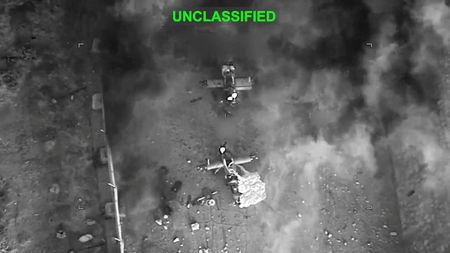
In February of the previous year, an object Ukrainian officials identified as a Russian long-range attack drone impacted the Chornobyl site, penetrating the radiation containment barrier.
The Kremlin rejected Russian responsibility at that time, claiming its military does not attack nuclear infrastructure and suggesting Ukraine had likely conducted the strike itself as a “provocation.”
The European Bank for Reconstruction and Development has calculated repair costs at a minimum of 500 million euros ($588 million) and warned that without such repairs, “irreversible corrosion” of the structure will commence within four years.
An investigation by Ukrainian state prosecutors concluded the Russian attack was most likely intentional, Kravchenko said.
This determination was based on the sharp angle investigators found the drone used when striking the containment barrier. During their final approach, explosive-laden attack drones typically plunge toward targets while accelerating until collision.
Kravchenko suggested Russian military forces were probably utilizing Chornobyl as a drone attack corridor to circumvent heavily defended areas of Ukrainian air defense systems.
Ukraine, operating with restricted air defense capabilities across territory twice the size of Italy, positions these systems near populated centers and vital infrastructure to maximize effectiveness against Russian assaults.
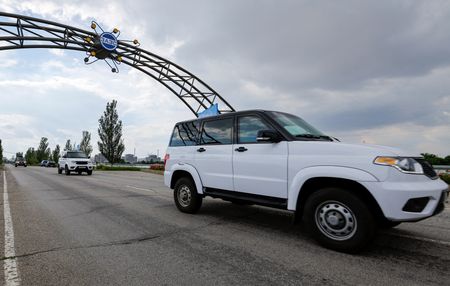
The Chornobyl complex, positioned less than 10 kilometers from the Belarus border and roughly 100 kilometers from Kyiv, sits within an exclusion zone of contaminated wilderness.