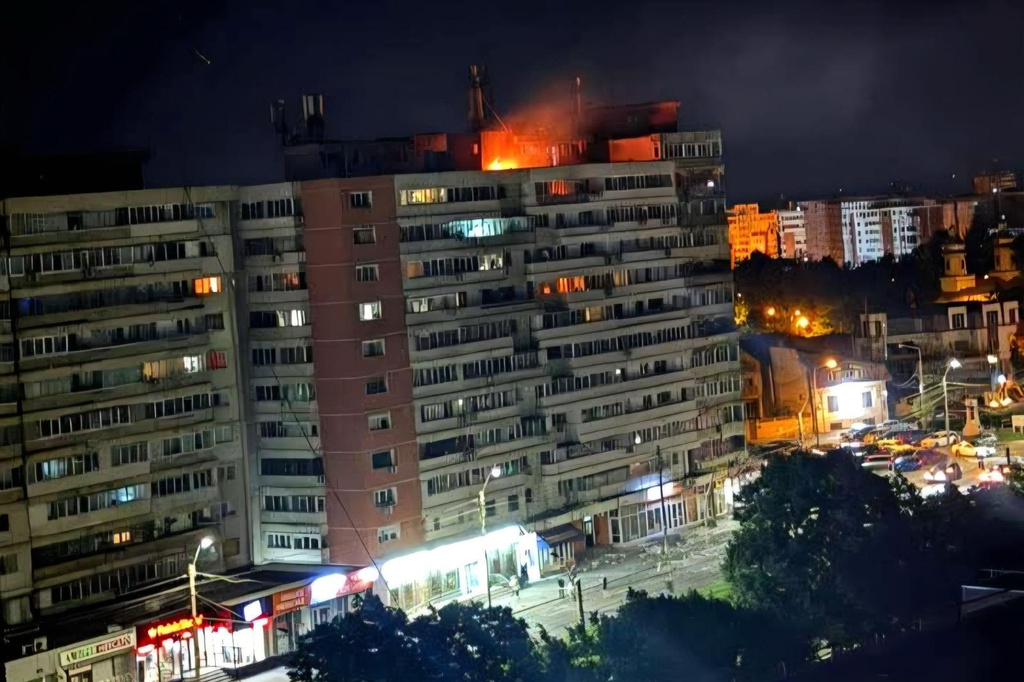

A Russian unmanned aircraft involved in nighttime strikes against Ukraine struck an apartment complex in eastern Romania, wounding two civilians in the NATO alliance nation, according to Romanian officials who expressed growing alarm that the four-year conflict might expand beyond Ukraine’s boundaries.
Following the incident in Galati, Romanian authorities requested expedited delivery of anti-drone technology from the military alliance, with the Foreign Ministry describing the aircraft’s path as a grave breach of international law.
This event represents the most recent in a series of unmanned aircraft episodes involving both Russian and Ukrainian drones that have troubled NATO member nations and heightened alliance tensions, prompting sharp criticism from Romania’s partners.
Gen. Gheorghe Maxim, serving as interim commander for Romania’s military joint staff, stated during Friday’s news briefing that the occurrence “is not an attack from Russia against Romania,” while noting that “Romanians should understand that Russia is a threat to the security of the countries in the area.”
Emergency responders and law enforcement arrived at the location in Galati, which sits along the Danube River close to Ukraine and Moldova’s borders.
Ukraine’s air force reported destroying 217 unmanned aircraft during Friday’s overnight period. Russia launched a total assault using 232 drones plus one ballistic missile, with strikes documented across 14 regions, military officials stated.
Romanian Defense Ministry officials confirmed radar systems monitored the drone’s movement through national airspace before it struck a building rooftop in Galati. The collision sparked a blaze, causing minor wounds to two individuals while prompting evacuations of additional residents.
Romania Describes Most Severe Incident Yet
Though Romania has previously discovered drone debris within its borders on numerous occasions since fighting began in 2022, including earlier this year in Galati during April, no injuries had occurred in previous incidents where most aircraft landed in unpopulated regions.
Responding to this latest breach, Romanian President Nicusor Dan assembled the NATO member’s highest defense council for Friday discussions regarding what he termed “the worst incident to hit the national territory” since Russia’s invasion of Ukraine, placing blame directly on Russia.
“We will have proportional measures in relation to the Russian Federation. … There is no ambiguity about the author and the cause of this assault,” Dan posted on Facebook.
The president added his concern for wounded individuals, families and residents “who experienced terrible moments in their own homes.”
Romanian forces deployed two F-16 fighter aircraft and one helicopter with authorization to engage targets, while emergency notifications reached residents in affected zones.
Airspace breaches have grown so frequent in Romania that legislators passed laws last year permitting military forces to destroy incoming drones as a final option. However, Romania has maintained restraint in shooting down wayward aircraft due to risks posed to populated communities.
Russia continues employing long-distance ballistic weapons and drones to target Ukraine’s electrical infrastructure and attack urban areas, while Ukraine prepares for additional heavy bombardments.
This latest episode compounds recent drone-related challenges facing Europe. During recent months, Ukrainian drones have struck a power facility smokestack in Estonia, damaged empty fuel storage in Latvia and been destroyed by Romanian fighter jets operating from Lithuania. Ukrainian leaders apologized, explaining the aircraft targeted military installations inside Russia but were diverted by Russian electronic interference.
Since hostilities commenced in 2022, Poland, Croatia, Romania and non-NATO nation Moldova have documented airspace violations and recovered drone wreckage on their soil.
These repeated airspace intrusions have raised concerns about air defense readiness along NATO’s eastern border.
International Partners Condemn Violation
NATO Secretary-General Mark Rutte confirmed speaking with Romania’s president and conveying the organization’s “absolute solidarity” with its partner.
Writing on X, Rutte stated he “affirmed that NATO stands ready to defend every inch of Allied territory. We will continue to enhance our readiness to deter and defend against any threat, including from drones.”
NATO partners are discussing the violation informally, though no formal session was scheduled for Friday. Romania may request official NATO consultations if it believes its territory or safety faces threats.
European Commission President Ursula von der Leyen described the incident as evidence that Russia “has crossed yet another line.” She indicated the EU would continue strengthening eastern border security while actively preparing additional sanctions against Russia, marking the 21st package to date.
“A Russian drone incursion struck a densely populated area in Romania, injuring civilians,” von der Leyen posted on social media. “On EU territory.”
Estonian Foreign Minister Margus Tsahkna attributed increased risk of such “serious incidents” to “Putin’s increasing nervousness, driven by military setbacks.”
Ukrainian Leader Seeks More Defense Systems
Ukrainian President Volodymyr Zelenskyy stated Thursday he was urging the United States to supply additional Patriot air defense systems capable of countering Russian strikes.
He cautioned that shipments to Ukraine are dangerously inadequate as the Iran war redirects and reduces U.S. inventory. “I believe (the U.S.) must act quicker. We are being very persistent,” Zelenskyy informed reporters while visiting Sweden.
U.N. Secretary-General António Guterres cautioned the U.N. Security Council that escalating and intensifying attacks threaten to spiral beyond control, creating “unknown and unintended consequences.” He noted more civilians died during this year’s first four months than during equivalent periods in the previous three years.
Guterres advocated for increased diplomacy, immediate de-escalation and “a full and unconditional ceasefire.”