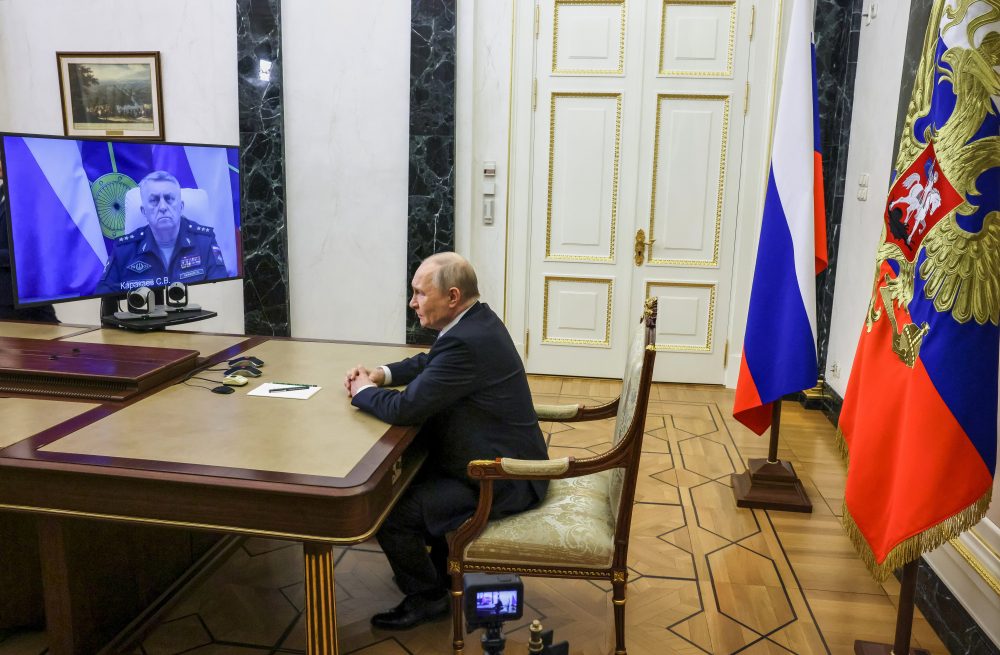

Russian President Vladimir Putin announced Tuesday that his country successfully conducted a test launch of its newest intercontinental ballistic missile, describing the weapon as part of ongoing efforts to upgrade Russia’s nuclear capabilities. The announcement came just days after Putin’s recent statements suggesting the conflict in Ukraine may be approaching its conclusion.
The nuclear-capable Sarmat missile is scheduled to begin active military service before the end of this year, according to Putin. The weapon is designed to take the place of the older Soviet-era Voyevoda missile system.
“This is the most powerful missile in the world,” Putin declared, explaining that the combined destructive capability of the Sarmat’s multiple independently targeted warheads exceeds that of comparable Western weapons by more than four times.
Putin has consistently used nuclear threats as a diplomatic tool since ordering Russian forces into Ukraine in February 2022, attempting to discourage Western nations from increasing their military assistance to Ukraine.
Following his participation in Saturday’s Red Square military parade marking the anniversary of Nazi Germany’s defeat in World War II—notably the first such parade in nearly twenty years without heavy military equipment on display—Putin stated that the Ukrainian conflict is nearing its conclusion.
Throughout his tenure since 2000, Putin has directed comprehensive modernization of Russia’s nuclear capabilities inherited from the Soviet Union, including deployment of hundreds of new land-based intercontinental missiles, construction of advanced nuclear submarines, and upgrades to nuclear-capable aircraft.
Russia’s nuclear modernization program prompted the United States to begin its own expensive arsenal upgrade initiative.
The final nuclear arms control agreement between Russia and the United States lapsed in February, marking the first time in over fifty years that the world’s two largest nuclear powers operate without restrictions on their atomic weapons stockpiles, raising concerns about an unlimited arms competition.
The Sarmat missile—known by the Western designation “Satan II”—is intended to replace approximately 40 Soviet-built Voyevoda missiles. Development of the weapon began in 2011, and prior to Tuesday’s test, the missile had achieved only one confirmed successful launch and reportedly experienced a catastrophic failure during a 2024 test attempt.
Putin explained Tuesday that the Sarmat—among several advanced weapons systems he unveiled in 2018 while asserting they would neutralize potential U.S. missile defense systems—matches the Voyevoda’s power while offering superior accuracy. The missile can achieve suborbital flight patterns, Putin noted, providing it with a striking distance exceeding 35,000 kilometers (21,700 miles) and enhanced ability to overcome potential missile defense barriers.
Among Moscow’s new weapon systems is the Avangard hypersonic glide vehicle, which can travel at speeds 27 times faster than sound. Initial units of this weapon have already been deployed.
Russia has also deployed the nuclear-capable Oreshnik intermediate-range ballistic missile, using conventional versions of this weapon twice in strikes against Ukraine. The Oreshnik’s maximum range of 5,000 kilometers (3,100 miles) allows it to strike any location across Europe.
Putin additionally revealed that Russia is approaching completion of two other advanced weapons: the nuclear-armed Poseidon underwater drone and the Burevestnik cruise missile, which operates using miniaturized nuclear reactors.
The Poseidon system is engineered to detonate near enemy coastlines, creating radioactive tsunamis. The Burevestnik possesses essentially unlimited operational range due to its nuclear propulsion system, enabling it to remain airborne for extended periods while circumventing air defense systems before attacking from unexpected angles.
Putin characterized these advanced weapons as Russia’s response to American missile defense systems developed following Washington’s 2001 decision to abandon a Cold War-era agreement that restricted missile defense capabilities.
Russian defense strategists have expressed concern that missile defense systems might encourage Washington to attempt a preemptive nuclear strike designed to eliminate most of Moscow’s nuclear forces, with the expectation of intercepting any remaining retaliatory missiles.
“We were forced to consider ensuring our strategic security in the face of the new reality and the need to maintain a strategic balance of power and parity,” Putin said.