
Universities throughout Russia are enticing college students with substantial monetary rewards to enlist in unmanned aircraft units operating in Ukraine, according to official documents reviewed by Reuters.
The targeted recruitment campaign unfolds as Russian military operations continue advancing in Ukraine during the conflict’s fifth year, with Moscow seeking to expand its drone capabilities through a specialized military branch established in late 2023 under President Vladimir Putin’s directive.
Russian officials maintain this represents standard volunteer recruitment rather than widespread mobilization. Dmitry Medvedev, who serves as deputy chairman of the Security Council, announced Friday that more than 400,000 individuals enlisted last year, with an additional 80,000 joining so far this year through the country’s ongoing volunteer system.
Kremlin spokesperson Dmitry Peskov acknowledged the student recruitment efforts when questioned by reporters Thursday, stating: “This (recruitment) offer exists; it is, as they say, on the market, and it applies equally to everyone: to workers, to students, to the unemployed, and so on and so forth. This is a completely open offer, an offer to join a new type of unit.”
The Far Eastern Federal University in Vladivostok presents students with comprehensive packages including guaranteed academic leave for one year minimum, complete tuition exemption upon return, complimentary housing, educational grants, and coverage for all required military gear.
Financial compensation reaches impressive levels by regional standards: initial yearly wages starting at 5.5 million rubles (approximately $68,433), plus a 2.5 million ruble signing bonus following training completion, monthly stipends of 240,000 rubles, and an additional 200,000 ruble payment directly from the university.
“This is not only an opportunity to prove yourself, but also a unique platform for social and career advancement, backed by unprecedented support measures,” the university declared in documentation released March 19.
Similar attractive offers emerge from Moscow State University of Civil Engineering, which promotes opportunities for students to become drone operators, engineers, or technical specialists through announcements on its official website.
The Russian State Hydrometeorological University in St. Petersburg also actively encourages student participation, advertising drone operator positions with annual compensation reaching 7 million rubles (roughly $87,000).
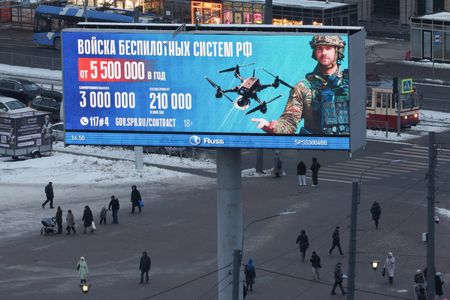
This academic recruitment strategy coincides with new advertising campaigns featuring billboard imagery of young drone operators wearing high-tech eyewear under the slogan “the new indispensables,” specifically targeting students in technical fields such as engineering and aeronautics.
Separately, Pavel Malkov, governor of the Ryazan region housing over one million residents, has mandated recruitment quotas for both private and public companies. His official decree requires businesses with up to 300 employees to provide two military recruits, companies with 500 workers to supply three recruits, and larger enterprises with over 500 staff members to contribute five recruits.
The quota system operates from April through September, with Malkov personally monitoring compliance, though the decree does not specify penalties for companies failing to meet requirements.
These recruitment efforts highlight Moscow’s emphasis on strengthening drone capabilities, as unmanned aircraft operations have become increasingly crucial in the prolonged conflict. Drone operators typically work away from front-line positions but face significant risks as high-priority targets when their locations become known to opposing forces.