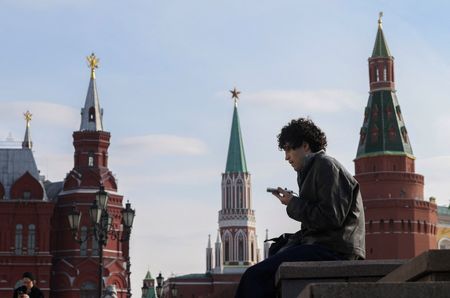

MOSCOW – Russian citizens are experiencing significant digital disruptions as the Kremlin implements sweeping internet restrictions across the country. Office employees face blocked websites, young people constantly switch between virtual private networks, and taxi operators navigate Moscow streets without digital mapping tools.
Moscow’s government has been systematically disrupting web access throughout various Russian regions while limiting access to popular messaging platforms Telegram and WhatsApp. Authorities have also eliminated numerous VPN services that citizens use to bypass online restrictions.
During the previous week, mobile internet service has been completely unavailable daily in sections of central Moscow, St. Petersburg, and additional major metropolitan areas, according to news correspondents and eight high-ranking international diplomatic sources stationed in Russia.
When questioned about limitations on messaging applications and internet access, Kremlin representative Dmitry Peskov confirmed to news outlets: “These measures are taking place.”
“They are partly related to the fact that a number of foreign companies refuse to comply with the norms of Russian legislation, and partly due to security measures against the threat of Ukrainian drones,” Peskov explained.
Military drones can utilize cellular infrastructure for navigation assistance.
This year’s digital restrictions in Russia have coincided with new legislation requiring mobile service providers to disconnect any customer upon Federal Security Service requests and granting the agency authority to establish its own network of pre-trial detention facilities.
The expanded digital control measures aim to help the Kremlin maintain internal stability during the ongoing Ukrainian conflict, according to diplomatic sources who spoke anonymously about sensitive matters.
If the conflict continues, it may progressively weaken public support, the envoys noted. When the war concludes, Russian leadership likely wants to prepare for potential domestic opposition, they added. One diplomat described Moscow’s assembled capabilities as enabling a potential “great crackdown” in cyberspace.
The conclusion of Moscow’s Afghan military involvement in 1989 triggered significant social upheaval in Russia, with returning military personnel contributing to widespread disorder throughout the 1990s. The turmoil intensified following the Soviet Union’s dissolution in 1991.
Russian investigative reporter Andrei Soldatov, who specializes in security service analysis, stated: “Russia’s leaders and security services remember 1991 and they remember what happened to Russia and what happened to them when Moscow stopped a big war in Afghanistan: the country collapsed, the security services were split apart — it was a disaster.”
“What is happening now is that the security services are trying to create a situation in which — if Putin signs a peace deal or if Putin goes for a protracted war — it would not destroy the whole thing,” Soldatov added.
Two Russian sources familiar with the digital restrictions revealed that Moscow examined other nations’ approaches, especially China and Iran, and assigned officials to develop methods for blocking extensive internet access, including both mobile and fixed connections, while managing online communications.
Following the 2022 Ukraine invasion, Russia enacted the most restrictive legislation witnessed since the Soviet era, expanding censorship authority and FSB influence, the primary KGB successor organization.
This year, Moscow has further escalated security measures. President Vladimir Putin, who worked as a KGB operative from 1985-1990, commemorated the Ukraine war’s fourth anniversary on February 24 by participating in the FSB’s annual Moscow conference.
He directed the agency to intensify counter-terrorism efforts — including Ukrainian attacks — while reinforcing the “information and digital space.”
Kremlin spokesperson Peskov stated that all actions were legally implemented to maintain security during the Ukraine conflict, which Putin characterizes as a Western confrontation.
Two Russian officials with Kremlin connections rejected claims that internet and messaging app restrictions were oppressive, describing them as necessary for enhanced security and national cohesion against Western attempts to create internal division.
Russia’s state digital and communications oversight agency, Roskomnadzor, did not respond to comment requests.
The eight diplomatic sources indicated Moscow’s internet restrictions this year exceeded anything they had previously witnessed in the nation.
Mobile internet access has been intermittently disabled in certain Russian regions for months, frequently following significant Ukrainian drone strikes. By mid-January, Russia had blocked over 400 VPNs, representing a 70% increase from late last year, according to Kommersant newspaper reporting.
Recently, the restrictions have intensified in Moscow, according to diplomatic sources and news correspondents, with the government also targeting Dubai-based Telegram and U.S.-owned WhatsApp.
Last month, Russia reduced Telegram’s service speed — the platform serves over 1 billion active users and is extensively used in both Russia and Ukraine — and investigated billionaire founder Pavel Durov in connection with a criminal terrorism case.
Russian authorities claimed Telegram had been compromised by Ukrainian and NATO intelligence services, resulting in Russian military casualties.
Telegram has rejected penetration claims and stated Moscow is attempting to force Russians toward MAX, a government-supported messaging application that educational institutions have been directed to use for parent and student communications.
Durov told news outlets: “Each day, the authorities fabricate new pretexts to restrict Russians’ access to Telegram as they seek to suppress the right to privacy and free speech. A sad spectacle of a state afraid of its own people.”
The Kremlin also completely prohibited WhatsApp last month for non-compliance with domestic regulations. The application’s owner, technology corporation Meta, criticized the action as detrimental to Russian citizens’ security.
Some young Russians pledged to circumvent the restrictions by adopting different VPNs as services face bans, not for political reasons but to access Western applications like Instagram and Snapchat, which face Russian limitations.
Andrei, who withheld his surname due to the situation’s sensitivity, questioned: “If these quite old politicians want to block everything, why have they not made any Russian apps that are interesting?”