
MANILA, Philippines — The Philippine government has lodged a strong formal protest with China over what it described as the portrayal of Filipinos as monkeys in an animated video released by a Chinese state-owned media outlet, calling on Beijing to have the content removed immediately.
Manila’s Department of Foreign Affairs announced Friday that a series of opinion videos and cartoons — most notably an animated clip posted to China Daily’s Facebook page on July 10 — focused on China’s refusal to accept a 2016 international arbitration ruling that struck down Beijing’s sweeping territorial claims in the South China Sea.
The roots of the dispute go back to 2013, when the Philippines brought the arbitration case after China took control of a shoal located to the west of the Philippines following a tense standoff. China disputed the tribunal’s authority, refused to participate in the proceedings, and dismissed the resulting ruling as illegitimate.
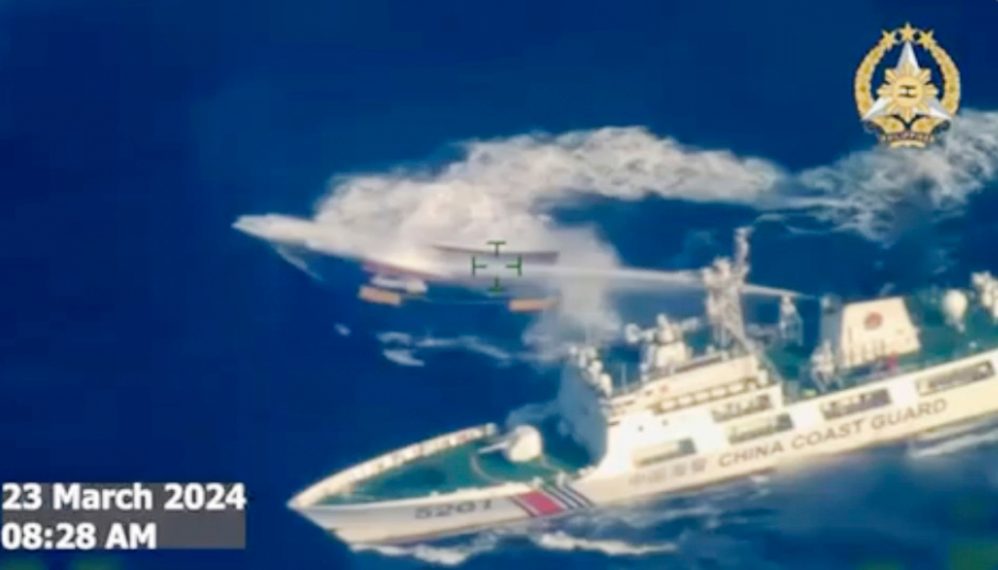
The China Daily video on Facebook depicts a monkey gripping a piece of paper labeled “South China Sea Arbitration Award,” dressed in what appears to be a traditional Philippine shirt, a rural hat, and worn-out pants. The clip then shows two hands — each sleeve marked with “USA” and “Japan” — throwing the monkey into the sea, where it is blasted by a water cannon from what appears to be a Chinese coast guard vessel.
The video’s caption ridicules the arbitration ruling, claiming it is not a path to peace “but a source of confrontation dressed up as law.” It also accuses Philippine politicians of “clinging to external forces and stirring up trouble in the South China Sea,” saying they are “turning their country into a pawn in someone else’s geopolitical game.”
The Philippines first conveyed its “firm objection to the offensive content” directly to Chinese Ambassador Jing Quan in Manila on Thursday. Philippine Foreign Undersecretary Leo Herrera-Lim “demanded that the materials be taken down, stressing that such content is inconsistent with the mutual respect expected between states,” according to the Department of Foreign Affairs.
In its formal protest, the department stated that “China Daily went beyond legitimate political debate by resorting to demeaning, dehumanizing, and racist depictions of Filipinos.” It further argued that “disagreement over legal and political issues does not justify resorting to imagery that has no place in the public discourse of responsible states.”
The Philippine Embassy in Beijing also sent a letter directly to China Daily’s editor-in-chief, repeating Manila’s demand that the offensive material be pulled down without delay.
At a press briefing in Beijing, China’s Foreign Ministry spokesperson Lin Jian stated Friday that the video “does not represent the official position” and declined to comment further on it.
However, Lin went on to characterize the South China Sea arbitration as “a political farce disguised as a legal proceeding,” and maintained that “the so-called award is illegal, null and void and has no binding force.”
The Philippine government marked the anniversary of the July 12, 2016 ruling as a significant victory for the rule of law over aggression.
The United States, the United Kingdom, more than a dozen other Western and Asian nations, and the 27-member European Union have all reaffirmed the validity of the ruling.
Clashes over territory in the disputed waters have grown more frequent in recent years, particularly involving Chinese, Philippine, and Vietnamese forces and fishing fleets. The long-standing disputes over the strategically important waterway — a major artery for global trade — also involve Malaysia, Brunei, and Taiwan.