
KYIV/NEAR DRUZHKIVKA, Ukraine — Russian forces are slowly fighting their way into Kostiantynivka, a pivotal stronghold in Ukraine’s eastern defensive corridor that Moscow has long sought to capture, even as progress along most of the roughly 1,200-kilometer front line has largely ground to a halt.
Combat has now begun to spill into the city itself. Senior Ukrainian military commanders reported last week that small groups of Russian soldiers are attempting to push into the city’s outskirts — a development that suggests street-level, close-quarters fighting may be on the horizon.
Kostiantynivka sits at the southern end of a chain of four critical settlements that form a defensive line Ukraine is relying on to hold the heavily industrialized Donetsk region in the country’s east.
Russia’s continued push toward the city highlights Moscow’s persistent advantage in troop numbers, even as Ukrainian mid-range drone strikes targeting Russian supply lines have degraded some of its battlefield capabilities, according to analysts.
Emil Kastehelmi of the Black Bird conflict analysis team in Finland put it plainly: “The effect (of mid-range strikes) hasn’t been so great that it would have forced the Russians to suspend their offensive. So even though Russia has been taking increasingly heavy losses in the rear, they are still able to continue their offensives, at least in certain sectors.”
Taking Kostiantynivka would give Russian forces a launching point to push northward along the defensive belt, which has become the central focus of their military campaign. However, analysts warn that any such advance would likely be prolonged and costly — potentially mirroring the brutal sieges seen in other eastern cities like Pokrovsk and Avdiivka.
President Vladimir Putin has repeatedly stated that Russia must gain full control of the Donetsk region before the war concludes. Ukraine still controls roughly one-fifth of the region after more than four years of conflict.
Putin said last week that Russian forces were on the verge of capturing Kostiantynivka, a city whose pre-war population of nearly 70,000 has dwindled to around 2,000 residents. Senior commanders of Ukraine’s 19th Army Corps pushed back on that claim in comments to Ukrainian media, calling it an exaggeration and saying their troops were eliminating small Russian units that had managed to enter the city.
Maj. Gen. Viktor Nikoliuk, who leads Ukraine’s eastern operational command, told Ukraine’s public broadcaster on Thursday that Kostiantynivka could continue to hold at the current pace, provided troop levels and resources remain steady.
While the situation on the ground is deteriorating for Ukrainian forces, the U.S.-based Institute for the Study of War said in a June 23 assessment that the Russian infiltrations are not sufficient to trigger “a rapid operational breakthrough.”
Nevertheless, Russian efforts to surround the city using pincer movements are steadily making it more costly for Kyiv to keep defending it, according to Ukrainian analyst Ruslan Mykula of the DeepState open-source mapping group. “A choice will have to be made: either raise the stakes or withdraw,” Mykula said. “And right now, the situation is such that the stakes are rising with each passing day.”
Kastehelmi added that the city’s fall “seems to be more of a question of time.”
Russian troops are also pressing on the northern end of the defensive corridor, threatening the cities of Sloviansk and Kramatorsk with regular air and drone attacks launched from roughly 15 kilometers away.
Ukrainian supply routes in the area are under sustained attack, with artillery, drones, and guided bombs striking infrastructure along the road running north from Kostiantynivka, according to troops stationed nearby.
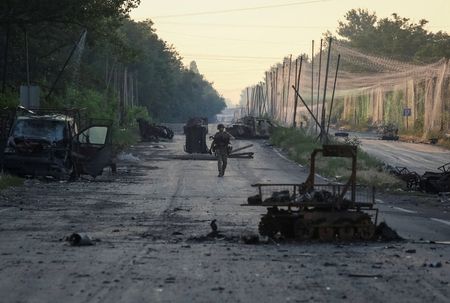
Reuters recently accompanied members of the “Predator” rifle brigade, part of the National Police, as they patrolled the battered supply route against drone threats and remotely dropped mines. Fiber-optic cable used to guide first-person-view drones was visible strewn across anti-drone netting stretched over the road, glinting in the intense summer heat.
Ground robots carrying food, water, and supplies — now the primary means of delivery within what soldiers call the “kill zone” — rolled back and forth along the route while soldiers zipped past on quad bikes.
Serviceman Oleksandr Kosmin, 34, explained that the route is far too dangerous for standard vehicles to carry out casualty evacuations: “Everything happens on foot.”
Civilian life in the surrounding area is collapsing under the weight of the ongoing fighting. In Druzhkivka, located about 12 kilometers to the north, residents are being forced to flee as the conflict creeps closer. On one tree-lined street, a husband and wife were found dead inside a van that had been struck by a Russian drone — white ribbons intended to identify the vehicle as civilian still fluttered from its roof.
Larysa Sereda, 59, spoke from inside a police evacuation vehicle as she prepared to leave. “Why am I leaving? Because I’m scared. Drones are flying,” she said. “But I plan to return home. I don’t want to stay in some strange place. The war will end, and I’ll come home.”
Russia’s slow advance around Kostiantynivka is unfolding despite growing pressure on its war effort from Ukrainian strikes on supply lines to and from Crimea, as well as longer-range attacks on Russia’s oil sector. Russian-installed authorities on the occupied Black Sea peninsula have declared a state of emergency to address economic problems and have suspended all fuel sales to individuals and businesses.
Across the broader battlefield, Russian forces appear stretched thin, with frontline assaults often involving only one or two soldiers at a time, according to analyst Mykula.
Still, Denis Pushilin, the Kremlin-installed leader of the occupied portion of Ukraine’s Donetsk region, told Reuters that Russia’s push to take more cities was ongoing. “Talking about whether this is happening slowly or quickly isn’t really the point,” he said.
Meanwhile, Russian hardliners have been pressuring Putin to walk away from the U.S.-backed peace process and escalate military operations as Ukrainian strikes intensify — including attacks reaching into Moscow itself.