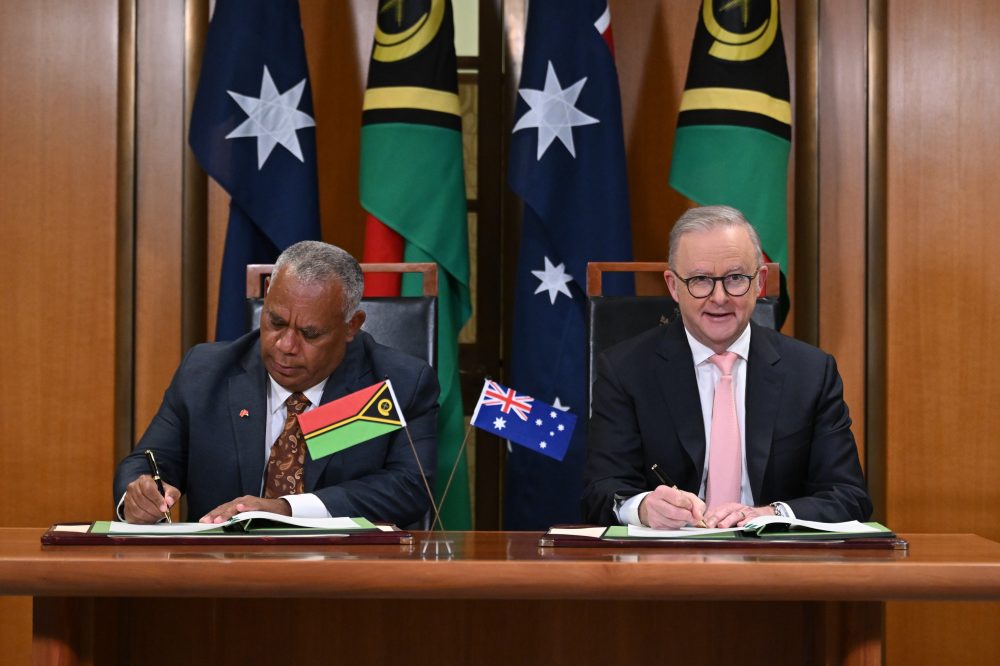

MELBOURNE, Australia — Australia and Vanuatu have officially signed a long-anticipated security and economic treaty that prohibits China from establishing a military base on the South Pacific island nation.
Australian Prime Minister Anthony Albanese and his Vanuatuan counterpart Jotham Napat put pen to paper on the so-called Nakamal Agreement in Australia’s capital on Monday. The signing came nine months after Vanuatu’s government turned down an earlier version of the deal, citing concerns that the original terms would restrict its ability to bring in infrastructure investment from other countries.
Speaking to reporters after the signing, Albanese said, “Our agreement reflects and confirms Australia’s role as Vanuatu’s largest and most comprehensive economic, security and development partner, a responsibility that we take seriously.”
Napat added that the pact “reaffirms our shared commitment to continuing and strengthening the comprehensive partnership between our two countries, founded on mutual respect, trust and our common vision for a peaceful, stable and prosperous Pacific.”
According to an official government statement, the agreement requires Vanuatu to prohibit any foreign military base or military-related infrastructure within its borders. It also mandates that the nation’s critical infrastructure remain free from militarization, foreign interference, or unauthorized access.
The Nakamal Agreement is part of a broader effort by Australia to strike security deals with neighboring Pacific nations in order to limit China’s growing influence in the region.
Under the finalized terms, Vanuatu must consult with Australia before entering into any third-party arrangements involving its critical infrastructure. However, unlike the original proposal, Australia does not hold veto power over those decisions.
The agreement also commits Vanuatu to giving priority to policing cooperation with members of the Pacific Islands Forum — a group of 18 countries and territories that includes Australia. Notably, the deal does not explicitly exclude Chinese police. While China does not maintain a permanent police presence in Vanuatu, Chinese police personnel do make regular visits to the nation, which has a population of approximately 350,000 people.
Additionally, Vanuatu has agreed to turn first to Australia, New Zealand, and France when responding to major natural disasters.
The original draft of the agreement had included a proposed financial commitment of 500 million Australian dollars — roughly $344 million U.S. — to be provided to Vanuatu over ten years. Albanese indicated that the financial details of the updated agreement would be released publicly by December.
Napat also addressed a separate agreement Vanuatu is negotiating with China, saying the details would be shared once the deal received “clearance from Beijing.” He has previously referred to that deal — known as the Namele Agreement — as a “comprehensive development cooperation” arrangement, stressing that it is not a security pact.
Vanuatu has received substantial loans and aid from China in recent years, funding the construction of buildings, wharves, and other infrastructure projects.
“Currently, it’s not yet signed. We will share the (Namele) agreement. There is nothing to hide. Our government is transparent and I am so grateful that the Prime Minister (Albanese) has also given me the clearance to share with them (China) the Nakamal Agreement,” Napat said.
The road to Monday’s signing was not without setbacks. Last September, Albanese was informed that Vanuatu had rejected a previous draft of the treaty just hours before he was scheduled to fly there for the original signing ceremony.