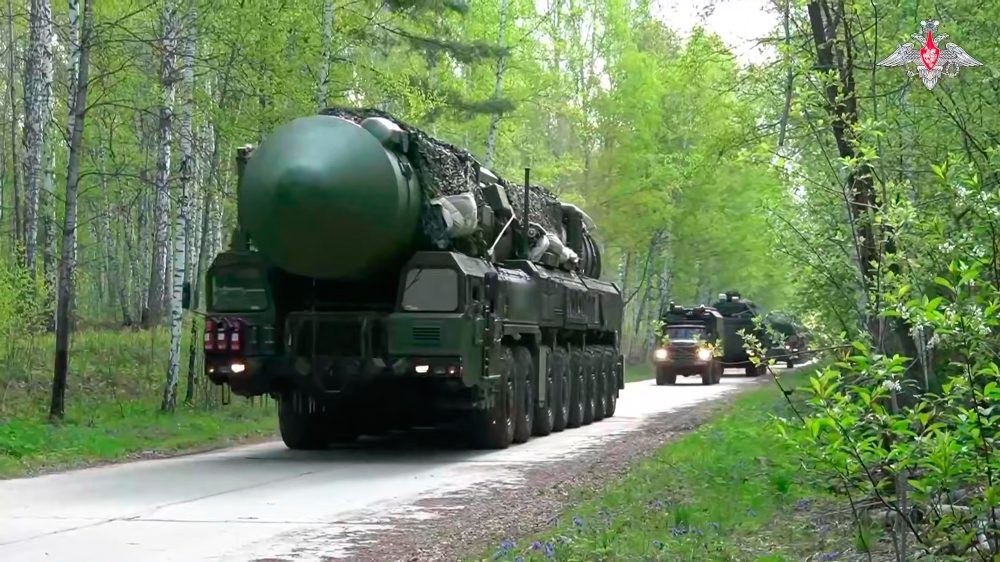

MOSCOW (AP) — Military vehicles transporting long-range ballistic missiles moved through wooded terrain, nuclear submarines departed from northern and Pacific naval bases, and flight crews launched aircraft as Russia and Belarus completed their joint nuclear military exercises on Thursday.
The president of Belarus, Alexander Lukashenko, examined Russian nuclear-capable Iskander short-range missiles at a military facility participating in the exercises, stating: “I dreamed about this machine a long time ago.”
The exercises, which lasted three days starting Tuesday, occurred during increased Ukrainian aerial attacks, including strikes on Moscow’s outskirts that resulted in three deaths and caused damage to multiple structures and industrial sites. These attacks have made it more challenging for Kremlin leadership to portray the Ukrainian conflict — now in its fifth year — as a remote situation that doesn’t impact ordinary Russian citizens’ daily lives.
According to Russia’s Defense Ministry, the military exercise included 64,000 personnel, more than 200 missile systems, over 140 aircraft, 73 naval vessels, and 13 submarines, with eight submarines equipped with nuclear warheads. The ministry stated the exercises would concentrate on “preparation and use of nuclear forces under the threat of aggression.”
The military exercises also rehearse coordination with Belarus, a partner nation that accommodates Russian nuclear armaments. Russian weapons stationed in Belarus include the newest intermediate-range nuclear-capable Oreshnik missile platform.
Russian President Vladimir Putin has consistently highlighted Moscow’s nuclear capabilities since deploying military forces to Ukraine in February 2022, seeking to prevent Western nations from increasing assistance to Kyiv.
During 2024, Putin approved an updated nuclear policy, stating that any conventional military action against Russia backed by a nuclear-armed nation would be viewed as a coordinated assault on his country. This warning was clearly designed to discourage Western powers from permitting Ukraine to attack Russia with extended-range weaponry and seems to substantially reduce the conditions for potentially deploying Moscow’s nuclear weapons.
The updated policy brought Belarus under Russian nuclear protection. Putin has indicated that Moscow will maintain authority over its nuclear weapons positioned in Belarus while permitting its partner to choose targets during potential conflicts.