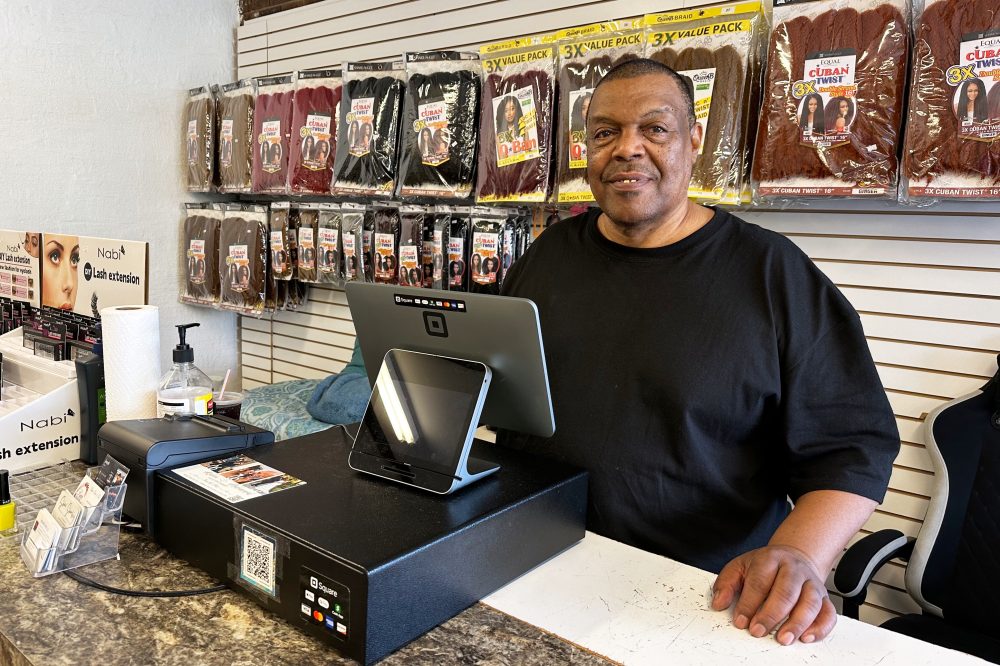

NASHVILLE, N.C. — At 65 years old, Ricky Brinkley has spent almost his entire life in rural North Carolina, preferring life “out in the county” away from the bright lights and activity of nearby small towns.
However, the retired truck driver feels overlooked during election season in this crucial swing state.
“People don’t come out like they should and ask you how you feel about things,” Brinkley explained while working behind the counter at his daughter’s beauty supply shop near the Nashville courthouse. “You want somebody to vote, but you don’t want to do nothing to get the vote. No, it don’t work that way.”
Brinkley represents a group of rural Black voters that Democrats have consistently struggled to engage as they attempt to challenge Republican dominance in these areas. This presents a critical challenge for a party that typically performs well with Black voters but struggles in rural communities.
Mobilizing these voters could help former Governor Roy Cooper secure victory in a competitive U.S. Senate contest this year and shift the balance of power in Washington. Such success might also transform presidential campaigns, offering Democrats an additional route to the White House.
“People want to look at the word ‘rural’ in North Carolina and equate it to the word ‘white,’” explained state party chair Anderson Clayton, a 28-year-old leader who secured her position three years ago by promising to extend the party’s reach beyond urban centers. “In my vision of a Democratic Party, when you talk about reaching out to rural voters, you are talking about rural Black voters.”
The Rev. James Gailliard, a former state legislator who pastors a large Black church in Rocky Mount, expressed the situation more directly.
“You don’t win this state in Durham,” Gailliard stated. “You win it in the east.”
While North Carolina is recognized for its university-rich Research Triangle encompassing Durham, Raleigh and Chapel Hill, plus Charlotte’s financial center, the state also contains vast expanses of small communities and rural territories where Democrats have steadily lost influence over recent decades.
This decline isn’t solely due to white voters shifting toward Republicans. It also stems from Black voters with Democratic leanings participating in elections less frequently than their urban peers. These rural Black communities are primarily located east of the triangle, spreading along curving state roads through small municipalities, flat terrain and agricultural areas toward the Atlantic shore.
Cooper, age 68, secured two gubernatorial terms and four terms as state attorney general. Nevertheless, Republicans maintain control of state courts and the legislature, and they’ve redesigned congressional boundaries to strengthen their position in the U.S. House. Donald Trump has delivered North Carolina to Republicans in all three of his presidential campaigns.
As a Nash County native, Cooper has already conducted roundtable discussions with Black farmers, entrepreneurs and community leaders in eastern North Carolina during recent months, along with students from North Carolina A&T University, a historically Black institution that attracts students statewide. His campaign pledges comprehensive organizing across the state before November.
However, Gailliard believes more action is necessary.
The founding pastor of Word Tabernacle Church, Gailliard was among the Black state legislators who lost their positions following Republican-controlled redistricting. He emphasized that regaining influence will demand grassroots organizing and investment from national Democrats, support he found difficult to obtain from Kamala Harris’ 2024 presidential campaign.
“I couldn’t get any traction,” Gailliard remembered. “I begged them to bring her to Rocky Mount. I said, ‘Listen, Rocky Mount is the gateway to the East. If we crack Rocky Mount, we’ve cracked the East.’ Could not convince them to come. Two weeks later, guess who’s in Rocky Mount? Donald Trump.”
The Harris campaign dispatched former President Bill Clinton to the region instead.
Gailliard noted that Cooper requires supporters like him to win election.
“Roy is a great friend, and I’m gonna run my butt off to help him in every way, but I’m not banking on his coattails,” Gailliard said. “I’m going to do the opposite. I’m going to grow coattails for him.”
Clayton, the state party chair, indicated that the national party and its financial backers haven’t focused on North Carolina early enough in recent election cycles.
She reported relying primarily on local funding to support 25 full-time staff members, more than triple the state party’s workforce before the 2022 midterm elections.
Bertie County Democratic chairwoman Camille Taylor, whose Powellsville hometown has under 200 residents, confirmed she’s noticed this transformation.
She maintains regular contact with a field organizer in nearby Greenville, the largest city near northeastern counties with significant Black populations. However, she noted it’s particularly challenging to convince rural voters to care about elections beyond the presidency, despite her message that “these are the races and the people that you’re going to interact with more.”
Democrats have fielded candidates in all 170 legislative districts — two are Democratic-leaning independents — and every U.S. House district. State Supreme Court Justice Anita Earls, a prominent civil rights lawyer and Black woman, is seeking statewide reelection.
Gailliard reported identifying several hundred nonprofits, neighborhood groups and other organizations capable of conducting issue-focused work in his district as the election nears. He aims to pair each organization with specific precincts, directing funding for them to contact voters and encourage participation.
He prefers training volunteers from Democratic and progressive organizations rather than having outsiders directly contact rural Black voters.
“We can’t have 21-year-old recent college graduates from Utah knocking doors at $22 an hour in the hood,” Gailliard said. “That just does not work. They’re not a trusted messenger.”
Approximately 2 in 10 North Carolina voters during the 2024 and 2020 presidential elections were Black, according to AP VoteCast, matching the 2022 Senate election.
About 4 in 10 Black voters in North Carolina’s most recent presidential election reported living in small towns or rural areas, comparable to the percentage living in suburbs. Only around one-quarter indicated they live in urban locations.
Minor changes in voter persuasion matter significantly, especially in tight races. In 2008, Barack Obama became the most recent Democratic presidential nominee to capture North Carolina, winning by just 14,000 votes among 4.3 million cast.
Voter participation between the 2020 and 2024 elections dropped more significantly in North Carolina counties with larger Black populations.
Counties where Black voters comprise roughly 30% to 40% of the electorate experienced the steepest decline, with participation falling by over 3 percentage points. Counties with smaller Black populations saw more moderate decreases of approximately 1 percentage point. Overall, participation remains higher in counties with fewer Black voters.
Gailliard emphasized that Democrats cannot undervalue the importance of simply requesting someone’s vote.
“Black and rural voters are not transactional,” he explained. “They are relational.”
Back in Nashville at the beauty supply shop, Brinkley concurred.
“You get to be a big wheel, and you can forget where you came from,” Brinkley observed. “I ain’t gonna say Roy forgot. He’s a hometown guy, so to speak, but I don’t expect to see him out here walking.”
Brinkley clarified that if he participates in voting, it would be for Cooper and other Democrats — but only if he decides to vote.
“I could. I could. I may vote,” he said. “There’s just so much going on.”